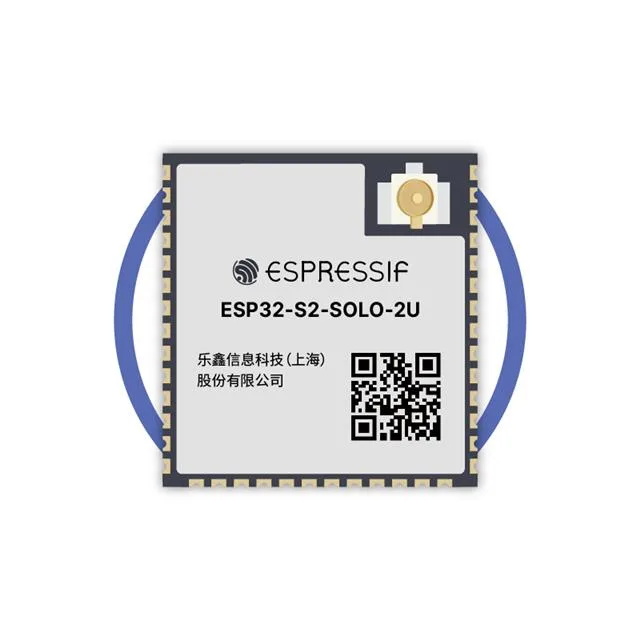
41-pin SMD module with integrated memory
The ESP32-S2-SOLO-2U-N4R2 is a surface-mount WiFi module from the ESP32-S2 series, packing the ESP32-S2R2 IC with 4MB of flash and 2MB of PSRAM in a 41-SMD Module package. The on-module memory stack means the design-in avoids external SPI flash or PSRAM routing — the 336kB of internal SRAM plus the 2MB PSRAM gives the application heap room for TLS stacks or larger frame buffers without adding a second memory die to the BOM.
WiFi link budget and power profile
This module supports 802.11b/g/n on 2.4GHz with a data rate ceiling of 150Mbps. The 19.5dBm transmit output power provides a strong link budget for industrial environments where signal must punch through metal enclosures or concrete walls — at this power level the module can maintain a connection at longer range than lower-power WiFi parts, though the current draw during transmission ranges from 165mA to 310mA depending on the output level and data rate selected. Receive sensitivity is -97dBm, which sets the noise floor for the link. In a clean RF environment this gives roughly 15-20 dB of margin above the noise floor at moderate range; in a noisy factory floor the co-channel interference will erode that margin, so the antenna placement and the board-level RF layout matter more than the bare sensitivity number. The receive current draw is 71mA to 75mA, which is low enough that a battery-powered sensor node spending most of its time in receive mode can still achieve months of operation on a 2000mAh cell, provided the duty cycle is managed in firmware.
Industrial temperature and peripheral set
The supply voltage range is 3V to 3.6V, which aligns with standard 3.3V rails; a 3.3V LDO with at least 500mA output capacity is recommended to cover the peak transmit current plus the module's own draw. The serial interface set includes ADC, GPIO, I²C, I²S, SPI, PWM, UART, and USB — enough to connect most common sensors, displays, and actuators without an external microcontroller. The USB interface is particularly useful for firmware bring-up: the module can enumerate as a USB CDC device for serial console access during development, eliminating the need for a separate UART-to-USB bridge on the debug header.