What does this dual op-amp actually do?
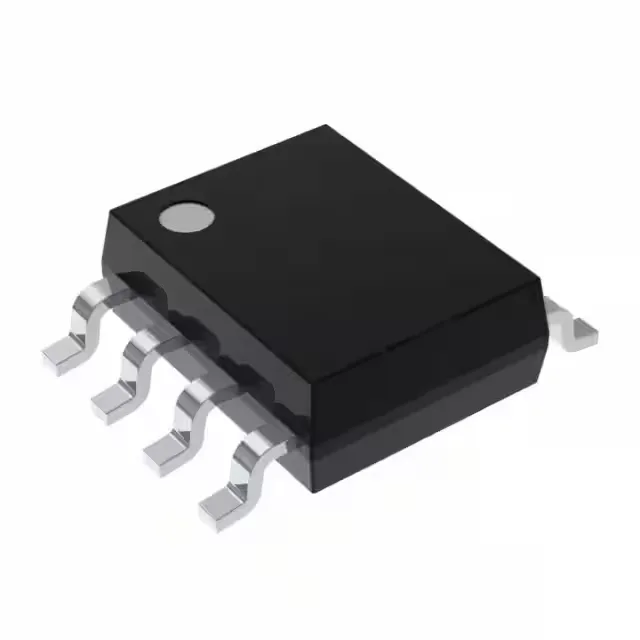
The MAX4167ESA+ is a dual general-purpose operational amplifier from Analog Devices, with two independent circuits in a single 8-SOIC package. It delivers a gain-bandwidth product of 5 MHz and a slew rate of 2V/µs, so it can handle audio-frequency signals and moderate-speed sensor conditioning without significant phase lag. The rail-to-rail output stage swings within millivolts of the supply rails, maximizing dynamic range in low-voltage designs running from 2.7 V to 6.5 V.
Key ratings and what they mean for your circuit
Each channel can source or sink 125 mA continuously — enough to drive a headphone load, a small relay coil, or the input of an ADC directly without a separate buffer stage. Input bias current is 50 nA typical, which is low enough for most general-purpose signal conditioning but not for high-impedance sources like pH probes or photodiode amplifiers — those would need a FET-input op-amp. The input offset voltage is 350 µV typical, so the DC error in a unity-gain buffer is under 0.35 mV — fine for 8- or 10-bit systems but worth derating for precision 16-bit paths. Supply current is 1.3 mA per amplifier (2.6 mA total for both channels), making it suitable for battery-powered portable gear where quiescent draw matters.
Package and deployment context
Housed in an 8-pin SOIC (0.154" body width, 3.90 mm), the MAX4167ESA+ is a surface-mount part that reflows on standard FR-4 with a 1.27 mm pitch footprint — no special via-in-pad or thermal pad required. Rated for -40°C to +85°C, it fits industrial control, automotive cabin, and outdoor telecom enclosures where ambient temperatures stay within that band. Supplied in a tube — the standard SOIC-8 tube quantity is typically 100 pieces per tube, which aligns with prototype and low-volume production runs.