What this op-amp is for and where it fits
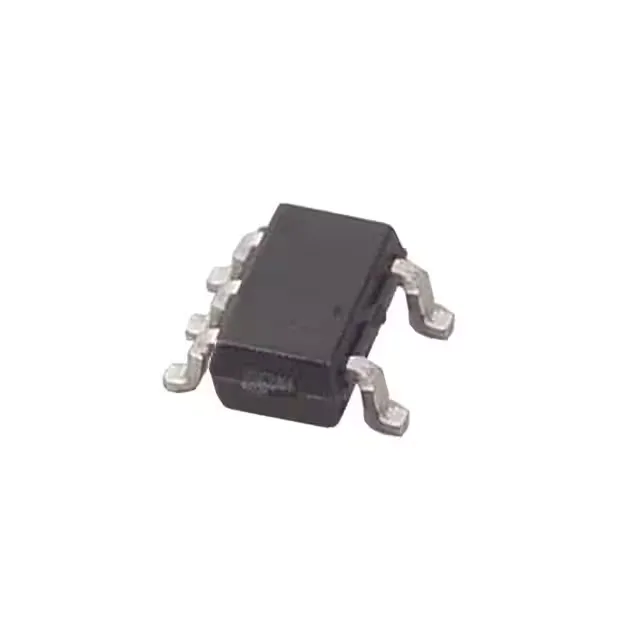
The MAX9914EXK+T is a single-channel general-purpose operational amplifier in an SC-70-5 package, designed for signal conditioning in low-power, space-constrained analog front-ends. Its 1 MHz gain-bandwidth product and 0.5 V/µs slew rate suit sensor buffering, active filtering below 100 kHz, and DC-level shifting in battery-operated instruments. The 1.8 V to 5.5 V supply span lets it run from a single Li-ion cell, a 3.3 V rail, or a 5 V industrial supply without a separate regulator — a practical advantage for mixed-voltage boards where the op-amp shares the ADC's reference rail.
Key parametric trade-offs for the BOM
Drawing 20 µA quiescent supply current, this part fits into battery-powered designs where every microamp counts — a sensor node waking once per second to read a thermistor or photodiode can run for months on a CR2032 without the op-amp dominating the sleep budget. Input bias current is 1 pA typical, which means negligible voltage drop across high source impedances — a 10 MΩ sensor sees only 10 µV of offset from bias current, making this part usable for pH probes, pyroelectric detectors, and other high-impedance front-ends without a separate buffer. Rail-to-rail output swing preserves dynamic range at low supply voltages — at 1.8 V the output can swing within 20 mV of each rail, so a 0–1.8 V ADC input range is fully usable without gain-stage headroom loss. Input offset voltage is 200 µV typical, which is adequate for general-purpose signal chains but should be budgeted into the system error budget for precision DC measurements — a gain of 100 amplifies this to 20 mV at the output.
Package and mounting reality
The SC-70-5 (SOT-353) footprint is 2.0 mm × 2.1 mm — one of the smallest five-pin packages available. The 0.65 mm pin pitch routes cleanly on a two-layer board, but the narrow body means the decoupling capacitor must sit within 3 mm of the supply pin to keep the 20 µA supply clean; a 0.1 µF X7R in 0402 fits directly adjacent. Surface-mount assembly with standard reflow profile — no special bake requirements for moisture sensitivity, though the tape-and-reel quantity should be confirmed at RFQ for the target build volume.
Lifecycle and compliance
Operating temperature range -40°C to +85°C covers industrial environments — factory-floor sensor interfaces, outdoor telecom cabinets, and automotive cabin applications (non-engine-bay).
Sourcing this part
Available through authorized and independent distribution — quoted to order against the BOM quantity. Tape-and-reel packaging (Cut Tape also offered) suits both prototype hand-assembly and production pick-and-place. Pricing and lead time confirmed at RFQ.