The differential input architecture rejects common-mode noise, which is useful when the signal source is remote or the ground reference is noisy — think industrial sensor bridges, data acquisition front-ends, or precision instrumentation. The 16-bit resolution gives a theoretical dynamic range just under 96 dB, so the design's noise floor and reference stability need to be commensurate to avoid leaving LSBs on the table.
Supply rails and interface — power and digital integration
The analog supply runs from 1.71 V to 1.89 V, while the digital supply can go from 1.71 V up to 5.5 V. That wide digital range means the ADC can interface directly with a 1.8 V, 2.5 V, 3.3 V, or 5 V logic bus without an external level shifter — the SPI/DSP serial interface connects straight to the host controller. The external reference input gives the designer control over the full-scale range and noise performance; a clean, low-drift reference is essential to preserve the 16-bit linearity.
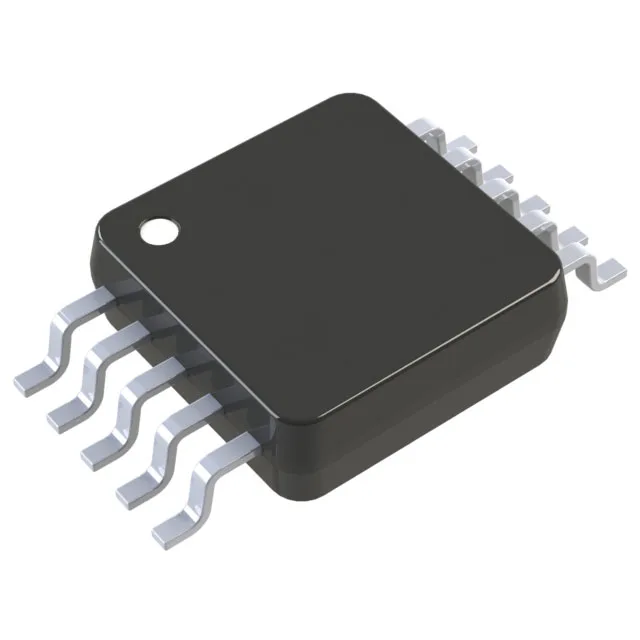
The 10-MSOP package (3 mm × 3 mm body) keeps the board footprint small, which helps when routing the differential input pair close to the signal source.