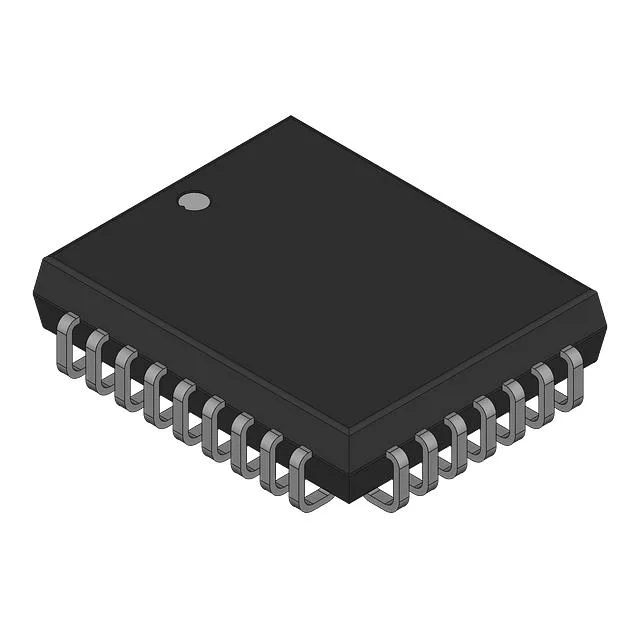
512 x 9 asynchronous FIFO, 25 ns access time — what the ratings mean for the bus
The AMD (Xilinx) AM7201-25JCTR is a 512-word by 9-bit asynchronous FIFO with a 25 ns access time. The 25 ns figure sets the minimum read-cycle window: at 4.5-5.5 V supply, the data bus must be strobed no faster than 40 MHz (1/25 ns) for guaranteed valid output, though the actual throughput also depends on the write-enable and read-enable handshake timing. The 9-bit width (512 x 9) accommodates an eighth parity or control bit alongside the data byte — common in legacy 8-bit bus systems where a ninth bit carries a tag or error-detection flag. The part is uni-directional, so data flows in one direction per FIFO instance; a bidirectional link requires two devices back-to-back. It draws 70 mA maximum from the 5 V rail — a 350 mW worst-case dissipation that the 32-PLCC package handles without forced airflow, but the thermal path through the J-lead solder joints to the board copper matters if the ambient is near the 70 °C ceiling.
Active production — no end-of-life watch needed
For a BOM that already carries this order code, the active status means the supply channel is the standard authorized-distribution chain. No special surplus or broker sourcing is required.
Package and supply — 32-PLCC J-lead, 4.5-5.5 V only
The J-lead footprint is a surface-mount solder joint, not a through-hole pin. It cannot operate at 3.3 V. The 70 mA maximum supply current is drawn from the 5 V rail; the actual current varies with the read/write duty cycle and the output load capacitance.
Feature set — retransmit, no FWFT, no programmable flags
The AM7201-25JCTR supports retransmit capability, which lets the FIFO re-read data from the beginning without a full reset — useful for packet retry in a communication buffer. It does not support First-Word Fall-Through (FWFT), so the first word written does not appear on the output until a read-enable strobe is asserted. Programmable flags are also absent; the flag outputs are fixed (empty, full, half-full) per the standard asynchronous FIFO architecture. The expansion type supports both depth and width cascading. Multiple AM7201 devices can be stacked to increase word count or data width, though the external logic for flag arbitration must be added by the designer — the part has no internal daisy-chain logic.