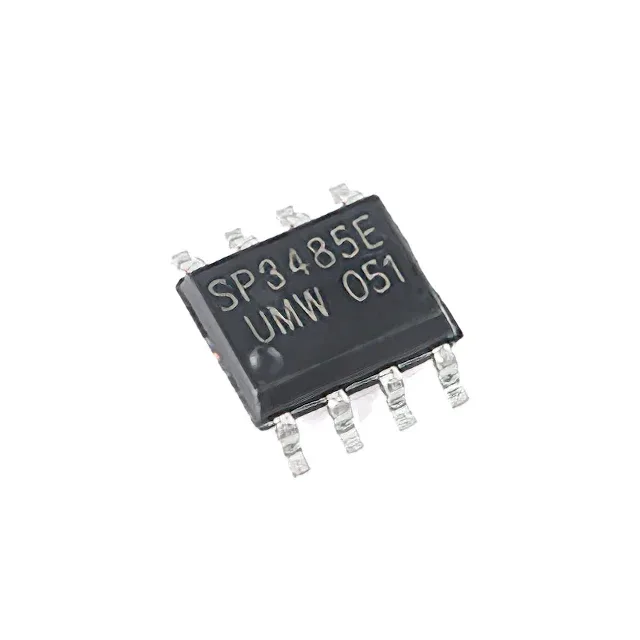
UMW ULN2003A
5A@50V 3V@2V,300MA 1.7V@350MA 0.
Full Technical Specifications
13 Parameters| Parameter / Attribute | Specification / Value |
|---|---|
| Input type | Inverting |
| Output type | Darlington |
| Type | Relay, Solenoid Driver |
| Mounting | Surface Mount |
| Voltage - load | 50V |
| Voltage - supply (Vcc (Vdd)) | Not Required |
| Output current | 500mA |
| I/O channels | 7 |
| Interface | Serial |
| Operating temperature | -40°C ~ 85°C |
| Package | Tape & Reel (TR); Cut Tape (CT) |
| Case | 16-SOIC (0.154\", 3.90mm Width) |
| Ratio - Input:Output | 1:1 |
Need Stock or a Drop-in Second-Source for ULN2003A?
Package: DIP-16 / SOIC-16 · Pin-compatible replacements with immediate Shenzhen spot stock
The ULN2003A is the seven-channel Darlington driver of relays, steppers, lamps and appliance boards - a DIP-16 that turns any logic pin into a half-amp sink with built-in clamp diodes, present by the million in repair benches worldwide. Its family story is deceptively simple: TI, Toshiba, KEC and ON parts cross-reference freely - except across one invisible line. The 2003-class parts carry 2.7k input resistors for 5V logic; the 2004-class carry 10.5k for higher-voltage CMOS. The last digit (03 against 04, KID65003 against KID65004, TD62003 against TD62004) is that line, and the repair literature that lists them as one family is exactly how a correct-looking substitution under-drives its inputs.
Verified Pin-Compatible Replacements (5 verified alternatives)
The Same Driver, Ten Times the Input Resistor
Shenzhen Spot Stock (24-48h Dispatch)
Identical 7-channel Darlington array with output clamp diodes and the same pinout - but 10.5k input resistors against 2.7k, for 6-15V CMOS drive rails instead of 5V logic.
Same 50V output class and 500mA per-channel rating; the difference lives entirely in the input network.
The 2003-Equivalent Second Source
Shenzhen Spot Stock (24-48h Dispatch)
The Motorola-line seven-Darlington driver with the 2.7k input network: the datasheet-level equivalent of the ULN2003A.
Same 50V / 500mA output envelope and clamp diodes.
The Korean 2003-Class Array
Shenzhen Spot Stock (24-48h Dispatch)
The KEC member of the 2.7k-input clan: interchangeable with ULN2003A, MC1413P, TD62003AP and the M54523/LB1233 row.
Same output envelope; the input class is the number - 65003 is the 2.7k part.
The Japanese 2003-Class Array
Shenzhen Spot Stock (24-48h Dispatch)
The Toshiba 2.7k member: the historical driver of Japanese appliance and office-equipment boards, interchangeable with the ULN2003A.
Same class; TD62004AP is the 10.5k sibling by the same digit rule.
One Channel Wider in Its Own Body
Shenzhen Spot Stock (24-48h Dispatch)
The eight-channel sibling of the same Darlington class: the same 50V / 500mA per-channel outputs and clamp diodes with the 2.7k input network, one channel wider and four pins longer.
Same output envelope; the COM pin moves with the wider body.
Buyer & Quality Checklist for Sourcing Alternatives
- The input-resistor rule is the whole family: 2.7k (ULN2003A / KID65003 / TD62003 / MC1413) for 5V logic; 10.5k (ULN2004A / KID65004 / TD62004 / MC1414) for 6-15V CMOS; ULN2002A carries a zener network for 14-25V drive. Read the full number before substituting.
- The COM pin is not optional wiring: it ties the internal clamp diodes to the load supply so inductive kickback (relays, steppers) is absorbed inside the array instead of on the driving logic.
- Outputs invert: a high input sinks the corresponding output to ground. The load goes between the load rail and the output pin, never the reverse.
- 500mA per channel is a per-channel figure under conditions: total package dissipation and simultaneous-channel current limit what a board can actually do. For heavier loads, parallel channels (the datasheets show the pattern) and re-check the saturation voltage stack.
- VCE(sat) around 1V at working current is the Darlington tax: at 500mA the channel dissipates half a watt. In sustained-duty designs compare against a MOSFET array (ULN2803-class voltage handling with modern low-side FETs) as a redesign option.
- The 100V interchange for higher-voltage systems is the SN75468 / SN75469 class - not a 50V ULN swap. Voltage arithmetic before part number.
Frequently Asked Technical Questions
Q: Is KID65004AP the same as ULN2003A?
A: No - it is the ULN2004A equivalent: same seven-Darlington driver and pinout, but a 10.5k input network for higher-voltage CMOS drive instead of the ULN2003A 2.7k. Its true 2003-class sibling is the KID65003AP. Repair literature routinely conflates the pair.
Q: What is the difference between ULN2003A and ULN2004A?
A: The input resistor: 2.7k (5V logic drive) against 10.5k (6-15V CMOS). The outputs are identical. A 2004A under 5V logic may not reach saturation; a 2003A under a higher-voltage source loads it harder - check the drive before substituting either direction.
Q: Can I drive a relay directly with a ULN2003A?
A: Yes - that is its design purpose: logic pin in, relay coil between the load rail and the output, COM tied to the load rail so the clamp diodes catch the kickback. Confirm the coil current sits inside the per-channel rating and watch the package dissipation with several channels active.