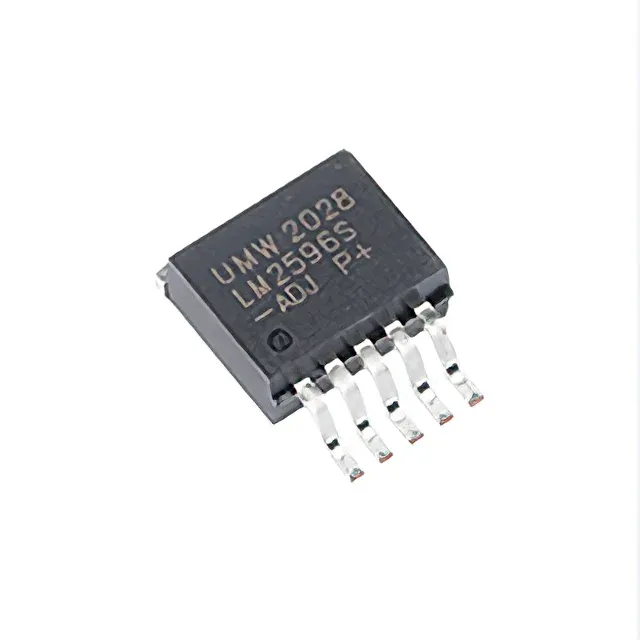
Texas Instruments LM2596S-ADJ — Power Management (PMIC / Gate Driver)
Technical Documents PDF / CAD
RoHS Compliant · Lead-Free EIA-481 Standard
Texas Instruments / Power Management (PMIC / Gate Driver)

LM2596S-ADJ Texas Instruments SIMPLE SWITCHER® Buck

MPN LM2596S-ADJ
Obsolete Spot Stock · 24-48h Dispatch 100% Original Sealed

Texas Instruments LM2596S-ADJ, SIMPLE SWITCHER® series, step-down buck regulator, 3A output, adjustable output voltage, surface-mount TO-263-5 package.

In Stock: 2,112 pcs
MOQ: 1 pcs
Logistics: DHL / FedEx DAP (Global Express · 3-7d) Russia & CIS DDP (Door-to-Door Cleared)
Dispatch: Shenzhen / HK
Unit Price (USD)
$0.77 / pc
Direct Purchase Ready
Volume Pricing Breaks Confirmed upon quotation
1+ pcs
$0.77
10+ pcs
$0.63
30+ pcs
$0.55
100+ pcs
$0.48
500+ pcs
$0.42
1,000+ pcs
$0.40
Working on a production BOM or have a target unit price? Submit Target Price
Buy Now

$0.77 / ea

2,112 in stock — maximum per order · 3–4 days lead time

$0.63 / ea from 10 pcs

Upload Full BOM List
[SPEC] Essential Parameters Snapshot Full Specifications (16)
Package / Case TO-263-6, D²Pak (5 Leads + Tab), TO-263BA
ALT
Facing long factory lead times or allocation on LM2596S-ADJ? Verified pin-compatible alternatives available with active Shenzhen stock and 100% solder-ready footprint match.

Full Technical Specifications

16 Parameters
LM2596S-ADJ specifications
Parameter / AttributeSpecification / Value
SeriesSIMPLE SWITCHER®
Output typeAdjustable
MountingSurface Mount
Voltage - input4.5V
Voltage - output37V
Voltage - output (Min (Fixed))1.2V
Output current3A
Frequency - switching150kHz
I/O channels1
Operating temperature-40°C~125°C(TJ)
PackageTube
FunctionStep-Down
TopologyBuck
CaseTO-263-6, D²Pak (5 Leads + Tab), TO-263BA
Output configurationPositive
Synchronous rectifierNo
100% Footprint Match · Solder-Ready (No PCB Redesign Needed)

Need Stock or a Drop-in Second-Source for LM2596S-ADJ?

Package: TO-263 / TO-220-5 · Pin-compatible replacements with immediate Shenzhen spot stock

Footprint Match 98%
Supply Chain & Allocation Reality:

The LM2596 is the adjustable 3A step-down of a million blue modules and a generation of industrial boards - 4.5V to 40V in, 1.23V to 37V out, and 150kHz switching that lets it use the small inductor, which is exactly where the markets best-documented fake story lives: module batches whose LM2596-marked chips behave like LM2576-class parts (about 50kHz) while the passives around them were picked from 2596 tables. The chip inside a cheap module is often not what the laser etch claims, and both the frequency and the physical inductor tell you which way the substitution went. Around the genuine part the family ladder (fixed and adjustable grades) and the modern MP1584/XL4015 alternatives complete the selection map.

Verified Pin-Compatible Replacements (4 verified alternatives)

LM2576 TI / multiple TO-263 / TO-220-5
Pin-to-Pin (Minor Clock/Init Tuning)
Availability & Target Pricing:

The 52kHz Ancestor - Closer Than the Name Suggests

Shenzhen Spot Stock (24-48h Dispatch)

Electrical & Core Specs:

The same 3A step-down topology and pinout at 52kHz instead of 150kHz: a valid substitute electrically, with one system-level consequence - the datasheet tables ask for a fundamentally larger inductor (about 100uH for the 52kHz part against 33uH for the 2596) or the ripple and efficiency change.

Same input family; HV variants of the 2576 extend the input ceiling where the standard parts stop.

Compatibility & Drop-In Notes: In the fake-module direction this is the tell: a module whose chip switches at about 50kHz and carries a 330-470uH inductor holds a 2576-class die under the LM2596 marking. Confirm with a scope on the switch node and a look at the inductor code.
Package & Solder Footprint: Same 5-pin outline (TO-263 / TO-220-5); the passive network around it is what differs.
Shenzhen Warehouse Stock & MOQ: Both lines stocked; quote them against the inductor the board actually carries.
XL2596 XLSEMI TO-263 / TO-220-5
100% Drop-in (Zero Code Change)
Availability & Target Pricing:

The Chinese Direct Equivalent

Shenzhen Spot Stock (24-48h Dispatch)

Electrical & Core Specs:

The XLSEMI drop-in for the LM2596 socket: same pinout, same adjustment behavior, produced in volume for exactly the module and repair trade.

Same functional envelope; validate per-lot switching behavior rather than trusting the family name.

Compatibility & Drop-In Notes: A drop-in by design; screen lots for switching frequency as with any part in this price band - the module fake story shows the substitution game that lives here.
Package & Solder Footprint: Same 5-pin outline.
Shenzhen Warehouse Stock & MOQ: Volume pricing; documented lots with photos before dispatch.
MP1584 Monolithic Power Systems SOIC-8 / module
Functional Equivalent
Availability & Target Pricing:

The Modern Small Upgrade

Shenzhen Spot Stock (24-48h Dispatch)

Electrical & Core Specs:

A different-generation buck: 4.5V to 28V input, about 3A, switching from several hundred kHz to 1.5MHz - small magnetics footprint and lower output ripple than the 2596.

Lower input ceiling (28V class) than the LM2596 40V family.

Compatibility & Drop-In Notes: Listed as the honest upgrade path: where a new board or a redesigned repair wants smaller and quieter, the modern parts win - but nothing about them is pin-compatible with a 2596 socket.
Package & Solder Footprint: Different package and footprint; board or module change, not a substitution.
Shenzhen Warehouse Stock & MOQ: Massive module and chip stock.
XL4015 XLSEMI TO-263-5
Functional Equivalent
Availability & Target Pricing:

The 5A Step Up in Current

Shenzhen Spot Stock (24-48h Dispatch)

Electrical & Core Specs:

The higher-current XLSEMI buck: up to 5A class with a cleaner output than the old 2596 design, in its own pinout.

Input from about 8V to 36V class depending on the datasheet revision - check the specific grade.

Compatibility & Drop-In Notes: Pinout differs from the 2596: a replacement in FUNCTION for overloaded designs, a board change in practice. Where the socket must stay, the 2596 family itself remains the answer.
Package & Solder Footprint: 5-pin outline, different pin assignment than the LM2596 - verify the drawing.
Shenzhen Warehouse Stock & MOQ: Volume stock; popular in the module trade.
Buyer & Quality Checklist for Sourcing Alternatives
  • Frequency is the design: LM2596 runs at 150kHz with a 33uH-class inductor; the LM2576 class runs at 52kHz and its datasheet tables ask for about 100uH. Any substitution across that line must carry the right magnetics or ripple, efficiency and stability all move.
  • The documented fake-module tell: an LM2596-marked module that switches near 50kHz and carries a 330-470uH inductor contains a 2576-class die. Scope the switch node and read the inductor code before trusting the marking.
  • The adjustable and fixed grades (ADJ / 3.3 / 5 / 12) are not interchangeable by part number: the fixed versions internally set the divider. In repair, match the grade; do not convert an ADJ socket by fitting a fixed part.
  • Feedback divider values are tuned to the specific output: changing grades or substituting regulators with different reference voltages silently shifts the rail - check the output under load, not just the marking.
  • Input above the 40V family ceiling: the 2596 class ends there; designs above it need the HV variants or a different family entirely.
  • In modules that died young, suspect the output capacitor and the inductor saturation first: the regulators in this trade are often paired with marginal passives, and the survival of a replacement part depends on them.
Frequently Asked Technical Questions

Q: What is the difference between LM2596 and LM2576?

A: Mainly switching frequency: 150kHz against 52kHz, with the same 3A step-down topology. The 2596 uses a much smaller inductor. They can substitute only together with the matching magnetics - and a fake 2596 module is exactly a 2576 die wearing the wrong marking.

Q: How do I spot a fake LM2596 module?

A: Two physical tells: switching frequency around 50kHz instead of 150 (scope the switch node), and a 330-470uH inductor where a genuine 2596 design uses about 33uH. The fakes regulate poorly at low output voltages and run noisier.

Q: Can I replace an LM2596 with MP1584 or XL4015?

A: As a function, yes - both are modern bucks with better ripple characteristics. As a socket, no: different pinouts and passives. They are redesign choices; where the board must stay, substitute within the 2596 family.

Technical Details & Description

3A adjustable buck regulator — what it does

The LM2596S-ADJ is a SIMPLE SWITCHER® step-down buck regulator from Texas Instruments, delivering up to 3A output from an input range of 4.5V to 40V. The adjustable output version lets you set Vout from 1.2V up to 37V with two external resistors. Switching frequency is fixed at 150 kHz, which keeps the inductor and capacitor sizes reasonable but means the part is not a candidate for noise-sensitive RF or audio rails — the ripple fundamental lands at 150 kHz plus harmonics.

Sizing the input and output rails

Minimum input is 4.5V, so a 5V rail with 5% tolerance is workable; the 40V max input covers 24V industrial supplies and 36V nominal telecom buses with margin. Output voltage is adjustable from 1.2V to 37V — the upper limit is Vout(max) = Vin - dropout, so a 40V rail can regulate down to 37V but not to 38V. The 3A current rating is continuous, not peak.

The adjustable version is no longer factory-supported.

Frequently asked questions

How can I order the LM2596S-ADJ or check stock?

The LM2596S-ADJ is obsolete per Texas Instruments. We source it through independent distribution channels. Submit an RFQ with your target quantity and any date-code or screening requirements — we quote to order.

Can the LM2596S-ADJ be replaced by a fixed output version like the LM2596S-3.3?

The fixed-output LM2596S-3.3 and LM2596S-5.0 share the same pinout and package (TO-263-5), so they are drop-in replacements if the output voltage matches. The adjustable version allows a Vout from 1.2V to 37V; a fixed-output part locks you to 3.3V or 5.0V respectively.

LM2596S-ADJ
Verified Allocation
Quote