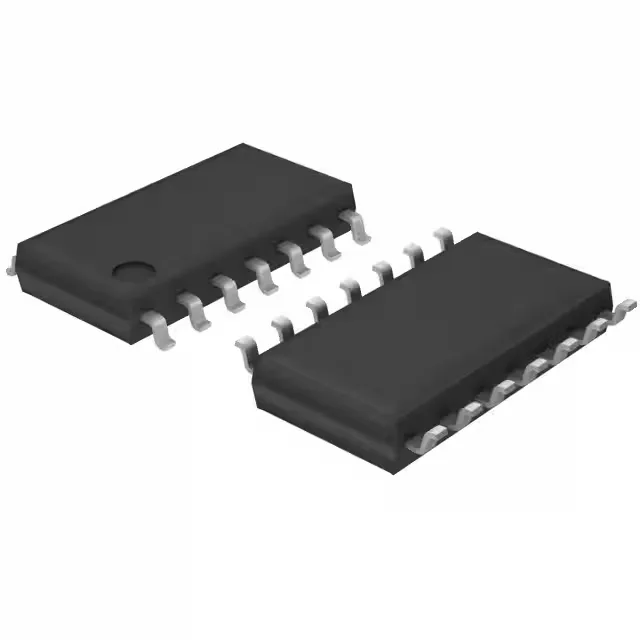
Quad 2-input XOR in the 4000B family — what the wide supply buys you
The BU4030BF-E2: The BU4030BF-: The BU4030BF- is a quad 2-input XOR (exclusive OR) gate from ROHM's 4000B series of CMOS logic ICs, housed in a 14-SOP surface-mount package. It operates across a 3V to 16V supply range, making it one of the few logic families that can bridge a 5V rail and a 12V industrial bus without a level shifter. Four independent XOR gates per package, each with two inputs, suit parity-check, data-comparison, and controlled-inverter circuits in systems where the power rail is not a fixed 3.3V or 5V.
Supply voltage and logic-level compatibility
The 3V to 16V supply range is the headline differentiator for this 4000B part. At VDD = 5V, the low-level input threshold is 0.5V, and the high-level threshold spans 4.95V to 14.95V depending on the supply. That means the BU4030BF- can accept a 5V logic input from a 74HC family output while driving a 12V relay or optocoupler directly — no extra translator. The wide supply also tolerates unregulated battery rails (e.g., 6V to 12V nominal) without a regulator.
Propagation delay and timing margin
Maximum propagation delay is 40 ns at VDD = 15V with a 50 pF load. At lower supply voltages (5V), the delay increases, typically to the 100 ns range. This is slower than a 74HC86 (around 10 ns at 5V), but the 4000B series trades speed for wider voltage tolerance and lower quiescent current. For clock rates under 5 MHz and general-purpose glue logic, the 40 ns figure leaves adequate timing margin.
Quiescent current and battery-operated designs
Maximum quiescent supply current is 4 µA across the full temperature range. This is the part you pick for a battery-backed comparator or wake-up XOR gate that stays powered continuously. The 1.2 mA output source and 3 mA sink currents are modest — enough to drive a CMOS input or a low-current LED, but not a relay coil directly.
ROHM lists the BU4030BF- as Active with ROHS3 compliance. For dual-sourcing or a faster logic family, see the FAQ entry on the 74HC86.