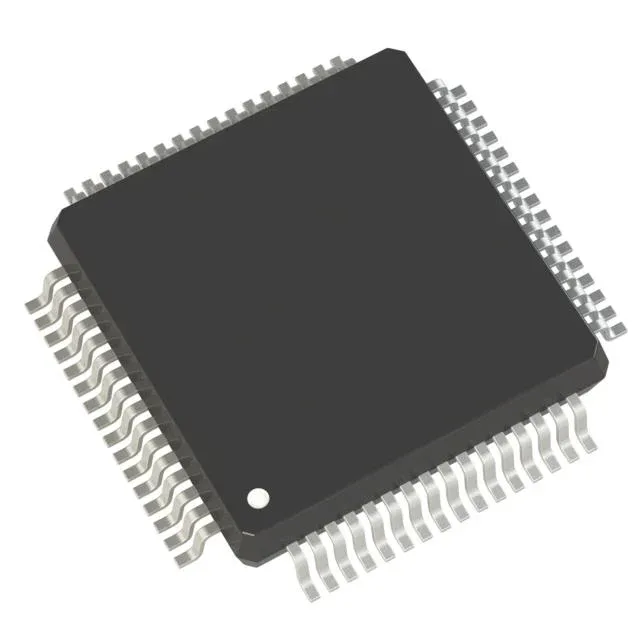
Core architecture and memory partition
The R7F100GPG2DFA#BA0: The RL78/G23 is a 16-bit core running at 32 MHz — the pipeline is optimized for single-cycle register-to-memory moves, so the effective throughput at that clock is higher than a generic 8-bit core at the same frequency. On-chip memory splits into 128 KB flash for code, 16 KB SRAM for data, and 8 KB EEPROM for nonvolatile parameters that survive resets without external storage.
Mixed-signal and peripheral complement
The ADC block provides 20 channels at 10-bit resolution and 8 channels at 12-bit — the 12-bit group is the one to use for precision sensor inputs that need better than 0.1% full-scale accuracy. Two 8-bit DAC channels handle analog set-points or audio bias. The capacitive touch unit supports self- and mutual-capacitance sensing without external charge-transfer ICs, which simplifies HMI overlay design. Serial interfaces include CSI (clock-synchronous serial), I²C, SPI, UART/USART, and LINbus — the LIN controller is hardware-accelerated for automotive body nodes. With 88 general-purpose I/O pins in the 100-LQFP package, most peripherals can be remapped to avoid PCB routing conflicts.
Supply and temperature envelope
The temperature range is -40°C to 85°C, which covers most factory-floor and outdoor equipment but stops short of under-hood automotive (105°C is available on the sibling R7F100GPG3CFB#AA0).
Internal oscillator eliminates the need for an external crystal in most applications, saving two I/O pins.
Production status and sourcing
For new designs the RL78/G23 family is still the recommended 16-bit platform.