32 MHz RL78 core with 256 KB flash — what fits in the memory map
The R7F100GMJ2DFB#BA0: The RL78 16-bit CPU runs at 32 MHz, giving you a 32 MIPS ceiling — enough for a PID loop at 10 kHz plus a Modbus RTU packet every millisecond without stalling the scheduler. 256 KB of program flash leaves room for a full RTOS kernel, a TCP/IP stack if you add an external PHY, and a 50 KB application image. The 24 KB RAM handles a couple of 1 KB buffers for serial comms and a 4 KB data log circular buffer; the separate 8 KB EEPROM stores calibration constants and fault history without wearing the flash. The 17-channel ADC can be configured as 8-bit for fast scans, 10-bit for sensor front-ends, or 12-bit for precision measurements — each channel independently assignable. The two 8-bit DACs output analog setpoints or reference voltages directly, no external converter needed.
Supply, temperature, and package — board-fit checklist
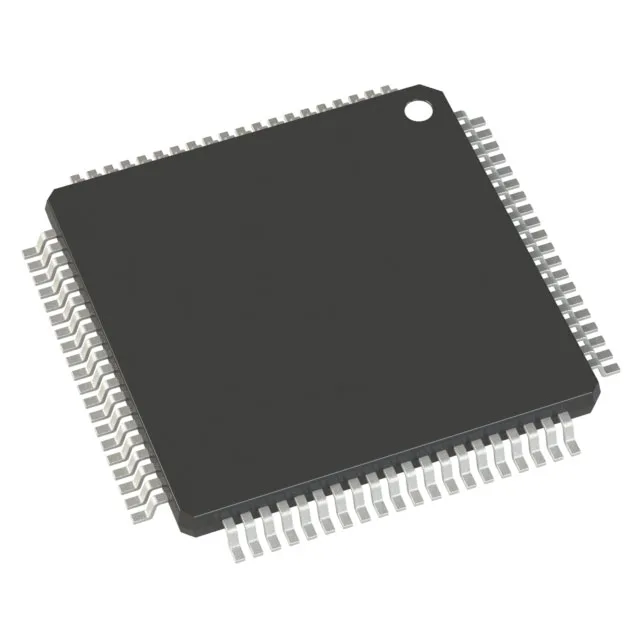
Runs from 1.6 V to 5.5 V, so it works on a single Li-ion cell (3.0-4.2 V) or a regulated 3.3 V / 5.0 V rail. Housed in an 80-LFQFP, 12x12 mm body — standard 0.5 mm pitch QFP. No exposed pad underneath, so a 2-layer board with a ground plane on layer 2 is sufficient for decoupling. The 70 I/O break out to all four sides; route the high-speed lines (SPI, UART) away from the oscillator pins. External oscillator required — a 32 MHz crystal or ceramic resonator on the main clock, plus a 32.768 kHz watch crystal for the RTC if you need timekeeping. The internal oscillator is not available on this variant, so the PCB must include the crystal footprint and load capacitors.
Peripherals for HMI and fieldbus — no external glue
Capacitive touch peripheral drives up to 16 self-capacitance channels without an external touch controller — good for membrane buttons or proximity sliders on a control panel. Connectivity includes CSI (clocked serial interface), I²C, LINbus, SPI, and UART/USART. LINbus is useful for automotive subnets; the four UARTs can each run at 115200 baud with a 16-byte FIFO, enough for a debug console plus two sensor streams. LVD (low-voltage detect) and POR (power-on reset) are built in — no external supervisor IC needed for brownout protection. The watchdog timer (WDT) is independent of the CPU clock, so it catches hangs even if the main oscillator fails.
Active production, ROHS3 — sourcing posture
ROHS3 compliant — no exemptions for lead, mercury, or phthalates, so it passes EU and global environmental regulations without paperwork exceptions.