192KB flash, 20KB RAM — memory headroom for a mixed-signal control loop
The R7F100GLH3CFA#BA0: The RL78/G23 core runs at 32MHz, giving you a deterministic 16-bit pipeline for real-time tasks like capacitive touch scanning or LINbus messaging without a separate co-processor. 192KB of program flash leaves room for a full HAL, RTOS kernel, and application code; the 20KB RAM handles data buffers and stack without thrashing. An additional 8KB of EEPROM holds calibration constants and boot parameters — no external serial EEPROM needed for non-volatile storage.
64-LQFP — hand-reworkable, no hidden pad
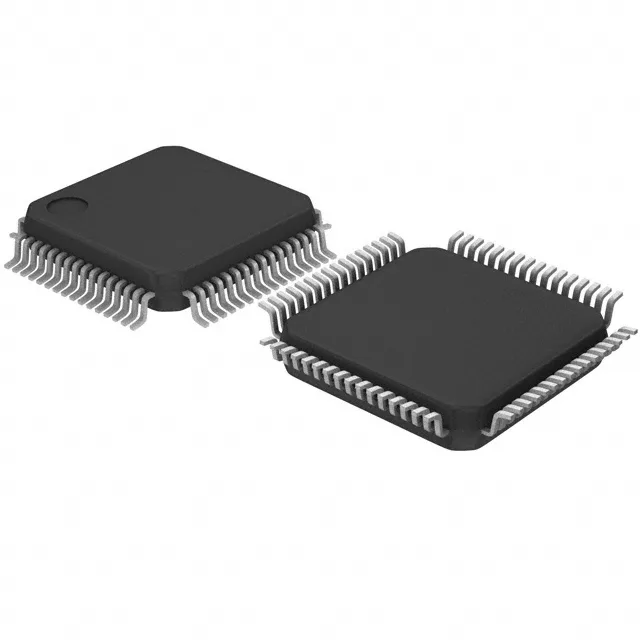
The 64-LQFP package measures 12x12mm with a 0.5mm pitch — the leads are exposed, so hot-air rework is straightforward. There is no exposed bottom pad to cook the board during removal; a standard QFP nozzle lifts the part cleanly. Pin 1 is marked by a chamfer on the mould compound and a dot on the top surface — no ambiguity when aligning the replacement part under the microscope.
Peripheral set — HMI and sensor fusion on one die
On-chip peripherals include capacitive touch sensing (self- and mutual-capacitance), a 12-channel 10-bit ADC and an 8-channel 12-bit ADC, plus a 2-channel 8-bit DAC — enough analog front-end for a multi-sensor node or a control panel with slider and wheel touch inputs. Serial connectivity covers CSI (clocked serial interface), I²C, SPI, UART/USART, and LINbus — the LIN controller makes this MCU a natural fit for an automotive-adjacent body-control module or an industrial sensor hub on a LIN backbone. 54 general-purpose I/O lines in the 64-LQFP package — enough to drive a segment LCD, read a matrix keypad, and manage a few external peripherals without an I/O expander.
Active production — no end-of-life clock ticking
The RL78/G23 series is a current mainstream line, so second-source risk is low. The 64-LQFP tray packaging suits both prototype builds and production runs.