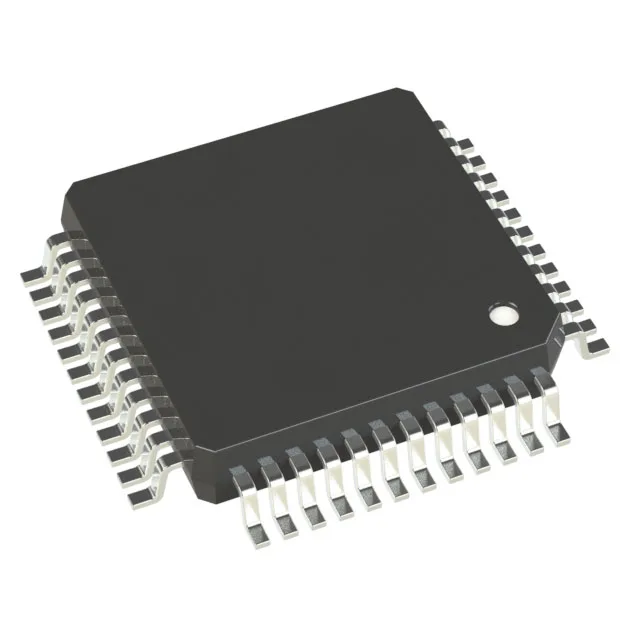
RXv3 core at 160 MHz — flash and RAM budget
The R5F566TEBDFL#10: The flash is split into separate read-while-write banks, so a firmware-over-the-air routine can erase and write one sector while executing from another — no need to shadow the bootloader into RAM. On top of the SRAM, there is 32 KB of dedicated EEPROM emulation space. That is enough to store calibration tables, fault logs, or production counters without wearing the main flash.
Peripheral mix and I/O count
The MCU packs CANbus, I²C, SPI, SCI (UART), SSI, and LINbus — enough to talk to a motor drive over CAN, log data to an SD card over MMC/SD, and stream sensor readings over SPI simultaneously. On the analog side, there are eight 12-bit ADC channels and two 12-bit DAC outputs. The ADC samples at up to 1 Msps — fast enough to capture a current-sense waveform for a field-oriented control loop. Internal oscillator means the part boots without an external crystal, though the precision is ±2 % over temperature — if you need a CAN bus or USB clock, you will still route a resonator to the EXTAL pins.
Package, temperature, and supply rails
That covers most factory-floor and outdoor enclosures, but if the junction sees sustained 105°C, step to the R5F566TEBGFL#10 variant which extends to 105°C.