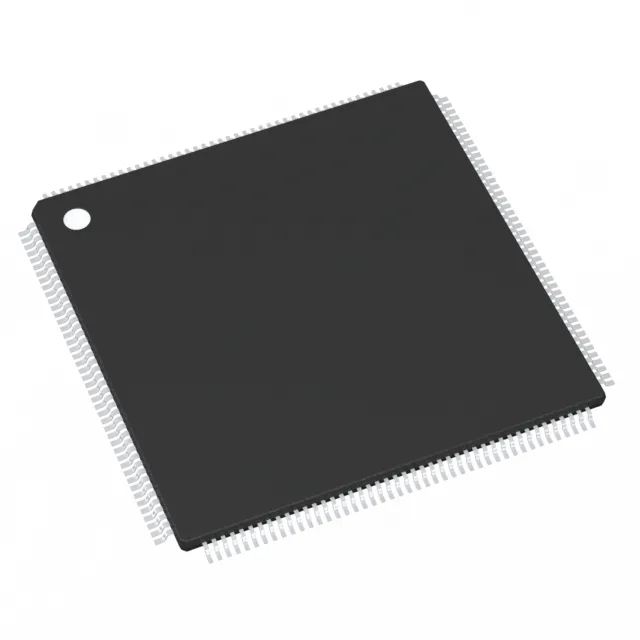
RXv3 core at 120 MHz — the throughput ceiling for a real-time control loop
The R5F56604GDFB#30 is a 32-bit MCU from the Renesas RX600 series, built around the RXv3 core running at 120 MHz. This clock rate sets the deterministic throughput for a control loop — a PID update or a fieldbus frame processing step completes within a fixed number of cycles, no cache-miss jitter. On-chip memory is split into 512 KB of flash and 128 KB of RAM. The flash holds the application binary and a bootloader; the RAM budget must cover stack, heap, and DMA buffers. A firmware image that fits within this split avoids external memory and the associated pin-out. An additional 32 KB of EEPROM emulation space is mapped on-chip — useful for calibration constants or event logs that need byte-level endurance without wearing the flash sectors.
Mixed-signal and connectivity — what the peripherals mean for the BOM
The ADC block provides 24 channels at 12-bit resolution, and the DAC block delivers two independent 12-bit outputs. For a sensor-fusion board measuring multiple analog inputs (thermocouples, strain gauges, current shunts) and generating a setpoint voltage, this eliminates an external ADC or DAC IC and the SPI/I²C bus traffic to it. The CAN and LIN controllers are useful for automotive or industrial sub-networks; the EBI/EMI can map an external SRAM or FPGA into the MCU's memory space without bit-banged GPIO. Peripheral set includes DMA, LVD (low-voltage detect), POR (power-on reset), PWM, and WDT. The DMA controller offloads the CPU for high-rate data transfers — ADC results to RAM, or RAM to SPI — without interrupt overhead.
Supply voltage and temperature — the operating envelope
A 5 V-tolerant I/O bank simplifies interfacing with legacy 5 V logic or sensors without a level shifter. This covers factory-floor enclosures, outdoor telecom cabinets, and under-hood automotive cabin applications (though not the full under-hood -40 to 125°C range). Package is a 144-LQFP with a 20x20 mm body (the supplier device package is 144-LFQFP). The 0.5 mm pitch demands a 4-layer PCB for reliable fan-out on the inner rows. The exposed paddle on the LFQFP variant improves thermal conduction to the board — a via-stitched copper plane under the paddle is recommended for continuous operation near the 85°C ceiling.
RoHS compliance is confirmed as ROHS3, covering the ten restricted substances plus the four phthalates.