Sigma-delta ADC and sensor fusion fit
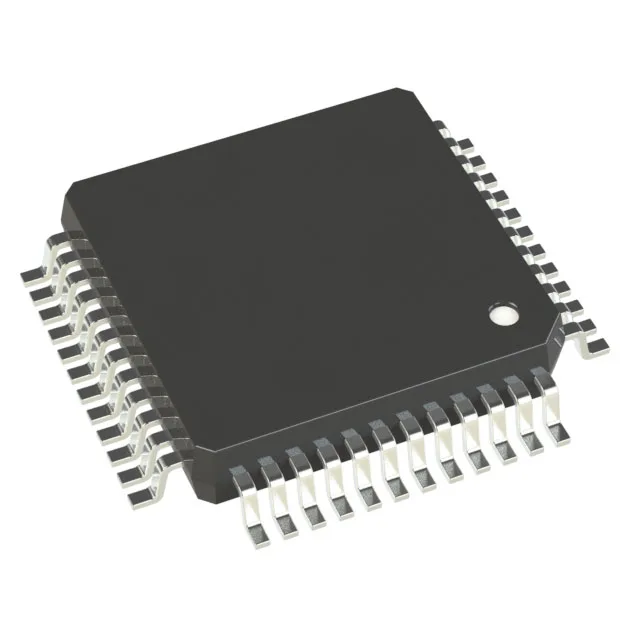
The R5F523E5SGFL#30 belongs to the RX23E-A series and carries 12 channels of 24-bit sigma-delta A/D converters alongside six 12-bit SAR channels — that is the headline reason to pick this over a plain RX MCU. The 8 KB EEPROM holds calibration coefficients and fault logs without an external serial EEPROM. The 32 MHz RXv2 core delivers about 165 DMIPS at 32 MHz from flash with zero-wait up to 32 MHz — the throughput ceiling is the flash wait-state profile, not the core clock. For a 1 kHz sensor read loop with a 24-bit filter settling time of a few milliseconds, the core idles most of the cycle.
Supply, temperature, and package
Mounting is surface-mount only. Sourced per RFQ through independent distribution.
Peripheral set and I/O budget
Connectivity includes CANbus, I²C, SCI (UART), and SPI — a typical sensor node needs one I²C for a digital sensor and one SPI for an external ADC or display; the remaining two can serve a debug UART and a CAN bus for field data upload. Only 16 I/O are available, so every pin allocation must be deliberate — a full CAN + UART + I²C + SPI configuration leaves about 8 GPIOs for buttons, LEDs, and interrupts. On-chip peripherals include DMA, LVD (low-voltage detect), POR (power-on reset), PWM, and WDT. The DMA can service the sigma-delta ADC results without CPU intervention, keeping the core free for higher-level processing. Oscillator options are external crystal or internal RC — the internal oscillator is accurate enough for UART and CAN at room temperature, but a precision external crystal is recommended for the sigma-delta ADC's sampling clock to avoid drift.