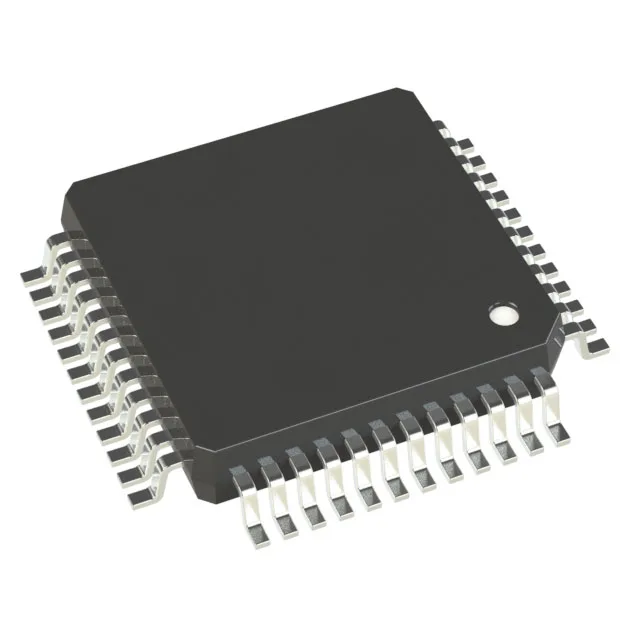
RXv2 core at 48 MHz — real-time control headroom
The R5F51406BDFL#30: The RXv2 core at 48 MHz delivers enough throughput for a single motor-control loop with sensor feedback or a CANopen node handling a few hundred PDOs per second. 256 KB flash and 64 KB RAM leave room for a modest RTOS, a communication stack, and the application logic without squeezing into a smaller part. The 8 KB on-chip EEPROM (8K x 8) stores calibration constants or boot parameters without an external serial EEPROM — one less BOM line and no I²C/SPI traffic to fetch them at power-up.
Peripheral set that reduces external count
On-chip AES and a true random number generator (TRNG) handle encryption key generation and data authentication without a separate security coprocessor. Capacitive touch sensing with the internal oscillator means a touch interface needs only the electrode traces and a firmware scan routine. The 11-channel 12-bit A/D converter (A/D 11x12b) covers analog inputs like thermistors, potentiometers, or current-sense resistors. With the internal oscillator and POR/LVD, the MCU starts up and monitors the supply rail without external reset or clock components. CANbus, I²C, SCI, and SPI (Connectivity: CANbus, I²C, SCI, SPI) cover the common industrial and sensor interfaces — a CAN transceiver on one side, an SPI ADC or display on the other, and an SCI UART for debug or Modbus RTU.
Supply and temperature — single-rail or battery operation
No separate I/O voltage rail is needed — the same supply powers the core and I/O. The 48-LQFP (7x7 mm) footprint (Package / Case: 48-LQFP, Supplier Device Package: 48-LFQFP (7x7)) is a standard 0.5 mm-pitch package — four-layer board fan-out is straightforward.
The 39 I/O pins (Number of I/O: 39) in the 48-LQFP package leave a few pins unused for future expansion — enough for a parallel LCD or extra sensor inputs without jumping to a larger package.