Active production — what that means for a BOM line
The R5F51138AGFP#1A: RoHS3 compliant, which covers the current EU substance restrictions.
Memory and peripheral map — the so-what for firmware
512 KB of on-chip flash and 64 KB of SRAM give this RX113 MCU enough headroom for a real-time control stack plus a modest application layer. The 8 KB dedicated EEPROM is a separate block — useful for calibration constants or configuration data that needs byte-level endurance without wearing the main flash. The peripheral set includes capacitive touch sensing, an LCD controller, DMA, and a full-speed USB OTG interface. That combination — touch + LCD + USB — targets human-machine interface (HMI) panels and appliance controllers where a small display and capacitive buttons replace membrane switches. The 12-bit resolution is typical for sensor feedback loops (temperature, pressure, current sense) where 10-bit was marginal and 16-bit is overkill.
Package, I/O, and supply — board-fit checklist
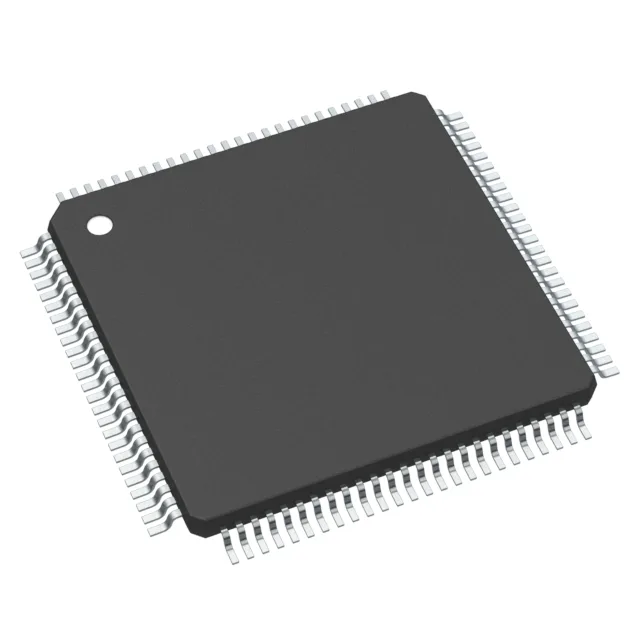
Housed in a 100-LQFP package with a 14x14 mm body. 82 general-purpose I/O are available. That is a high pin-to-package ratio — expect most of the peripheral signals (LCD segment lines, USB D+/D-, touch electrode channels) to be muxed onto these pins. Map the peripheral allocation against the I/O count early in the schematic phase. Industrial temperature grade: -40°C to +105°C ambient. This covers outdoor telecom cabinets, engine-bay-adjacent electronics, and factory-floor enclosures without active cooling — the 105°C ceiling is the key differentiator versus a commercial-grade part that tops out at 85°C.
Sourcing posture
Sourced through independent distribution channels.