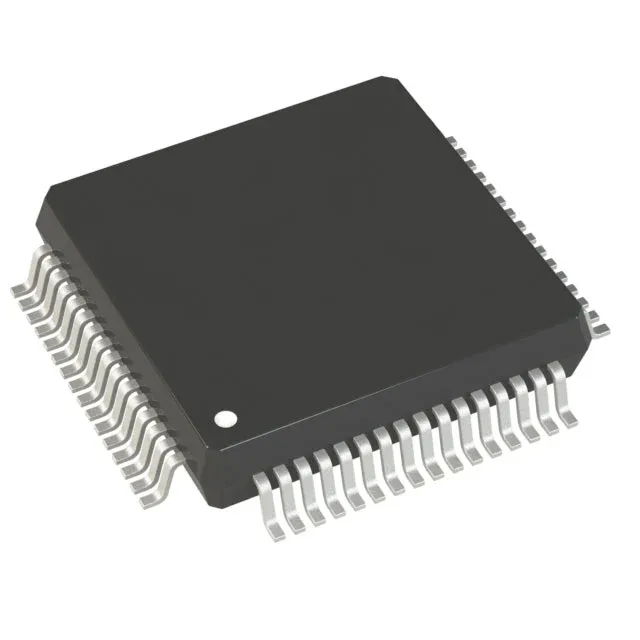
RX110 core: 32 MHz, 96 KB flash, 16 KB RAM — what fits in that envelope
The R5F51104AGFK#30 is a 32-bit RX-core microcontroller from the RX110 series, running at 32 MHz with 96 KB of on-chip flash and 16 KB of SRAM. That flash-to-RAM ratio (6:1) is typical for a control-oriented MCU — the flash holds the application and constant tables, while the 16 KB RAM must cover the stack, heap, and all volatile data. A firmware engineer budgeting for a modest RTOS (say 2–3 KB kernel footprint) plus a few communication buffers will find the RAM tight; the DMA engine can offload peripheral data movement without CPU intervention. The 32 MHz clock is generated from an internal oscillator, so no external crystal is required for basic operation — the oscillator type is internal. This saves two pins and a board-layer routing headache, but the internal RC accuracy (±2% typical across temp) means any precision timing (CAN bit timing, UART baud rates above 115200) should use the external oscillator input if the application demands it.
64-LQFP package: 50 usable I/O and the board-fit constraints
That 50-I/O count is the number a layout engineer needs to budget for: if the design requires more than 50 digital signals, a larger package or a port expander is needed. The 14-channel 12-bit ADC is the only analog conversion resource — 14 analog inputs multiplexed into a single SAR core. The LVD (low-voltage detect) peripheral can trigger a reset or interrupt when the supply dips below a programmable threshold — useful for brown-out recovery without an external supervisor.
Supply range and temperature grade: where this MCU lives
At 1.8 V the internal regulator drops the core voltage, and the maximum operating frequency may be derated (the 32 MHz figure is typically specified at 3.3 V). A BOM cost engineer should note that the wide range allows a single MCU to serve both a 3.3 V sensor board and a 1.8 V memory interface without a level shifter on the supply side. The industrial temperature grade spans -40°C to +105°C (TA). This is the full automotive-underhood range minus the 125°C peak — suitable for outdoor telecom enclosures, motor-drive compartments, and engine-bay-adjacent electronics that see sustained 85°C ambient. The 105°C ceiling is the junction temperature limit for the flash retention; above that the data retention time drops below the 20-year target.
Active production — no end-of-life watch needed
The ROHS3 compliance covers the current EU RoHS exemption list, so no restricted-substance risk for EU-market products. The part ships in a Tray — the standard delivery format for LQFP packages in production volumes.