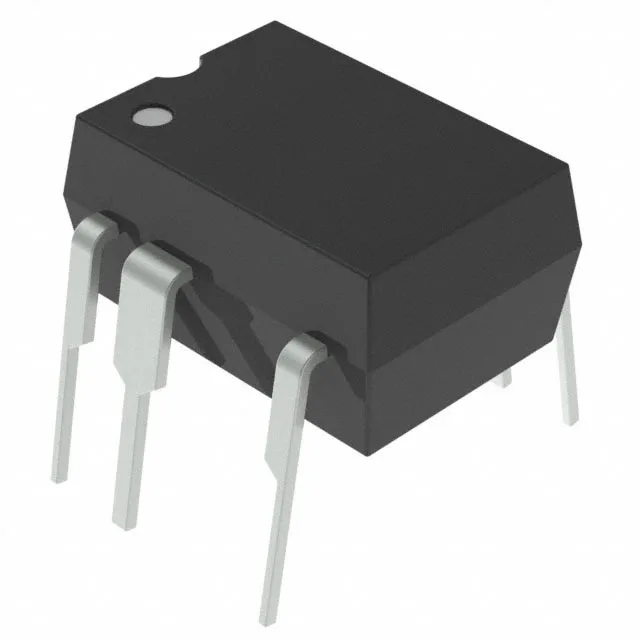
TNY275PG - Power Integrations
IC OFFLINE SWITCH FLYBACK 8DIP
Full Technical Specifications
14 Parameters| Parameter / Attribute | Specification / Value |
|---|---|
| Series | TinySwitch®-III |
| Mounting | Through Hole |
| Voltage - breakdown | 700V |
| Power (Watts) | 15 W |
| Frequency - switching | 132kHz |
| Duty cycle | 65% |
| Operating temperature | -40°C~150°C(TJ) |
| Package | Tube |
| Topology | Flyback |
| Case | 8-DIP (0.300\", 7.62mm), 7 Leads |
| Control features | EN |
| Fault protection | Current Limiting, Open Loop, Over Temperature, Over Voltage, Short Circuit |
| Output isolation | Isolated |
| Internal switch | Yes |
Need Stock or a Drop-in Second-Source for TNY275PG?
Package: DIP-8C (P) / SMD-8C (G) · Pin-compatible replacements with immediate Shenzhen spot stock
The TinySwitch-III row is the power supply of an ocean of adapters, chargers, LED drivers and appliance supplies: one 700V MOSFET, a controller, and a feedback scheme simple enough for a five-component design. The family runs TNY274 to TNY280 as a power ladder - 6W to 20W adapter duty at 230V, halved on universal input - with identical pinouts and one of the most useful easter eggs in power integration: the bypass capacitor value selects the current limit, letting one board cover two adjacent rungs. Buyers get this family wrong in one direction only: fitting a smaller member where the load needs the larger, which shows up as start-up hiccups and thermal shutdown, not as a dead board.
Verified Pin-Compatible Replacements (4 verified alternatives)
One Rung Down - The BP Cap Already Knows
Shenzhen Spot Stock (24-48h Dispatch)
The 10W-class member (230V adapter duty; 7W universal) with the same pins, the same 132kHz switching and a lower MOSFET current limit (350mA against the 277s 450mA typical).
Same 700V internal MOSFET and family envelope.
One Rung Up - The Common Repair Direction
Shenzhen Spot Stock (24-48h Dispatch)
The 16W-class member (10W universal): the usual upward substitution when a 277-class supply runs at its ceiling or the load grew.
Same envelope; current limit 550mA typical against 450mA.
The Ladder Top
Shenzhen Spot Stock (24-48h Dispatch)
The 20W-class member (14W universal input; about 36W peak): the top of the row with the same pins and the 750mA-class current limit.
Same 700V MOSFET class - the ceiling of what the family will pass without external parts.
The Sibling Family - Same Idea, Its Own Envelope
Shenzhen Spot Stock (24-48h Dispatch)
The LinkSwitch family member: the same self-powered offline philosophy aimed at smaller loads, appearing beside the TinySwitch parts in the same repair drawers and the same charger boards.
Its own power class and design envelope - read the datasheet rather than assuming cross-family equivalence.
Buyer & Quality Checklist for Sourcing Alternatives
- The digits are a power ladder, not a voltage or feature code: TNY274 6W through TNY280 20W adapter duty at 230V, roughly halved on universal input. Size the substitute against the design power at the worst input, not the nominal.
- The BP/M capacitor is a second current-limit selector: 1uF selects the next smaller members limit, 10uF the next larger (TNY275 and above; the TNY274 cannot go higher). Board and cap together decide what the supply will deliver before foldback.
- Upward substitutions are safe when the physical and thermal design matches; downward substitutions must fit the load at low-line input or the supply hiccups at start-up - the failure looks like a timer, not a short.
- The bypass capacitor working voltage and type matter (the datasheet calls for a specific class): a common repair failure is a generic capacitor where the design expected the specified one, moving the effective current limit.
- This family is the classic fake-and-clone zone for charger repair: verify lots; the behavioral screen is output power at low-line input under full load, which exposes mis-graded members in one measurement.
- Thermal design is the ceiling: these parts run hot by design in sealed adapters - a substitution one rung up buys electrical margin only if the thermal path actually improved.
Frequently Asked Technical Questions
Q: What is the difference between the TNY274 and TNY280?
A: Only the internal MOSFET current rating, expressed as output power: roughly 6W to 20W adapter duty at 230V input. Identical pinout and architecture across the row, and the bypass capacitor can shift the effective limit one rung either way on the TNY275 and above.
Q: Can I fit a bigger TNY part in a smaller design?
A: Electrically the larger member works when the load fits, and its limit can even be trimmed down with the 1uF bypass capacitor trick. Confirm the thermal path and the transformer ratings - the silicon rung is only half of a power supply design.
Q: Is LNK364 a drop-in for TNY277?
A: Same family of offline switchers with similar packaging, but a different power envelope and feedback behavior - an engineering substitution, not a drawer swap. Verify the design against the substitute datasheet before quoting it as equivalent.