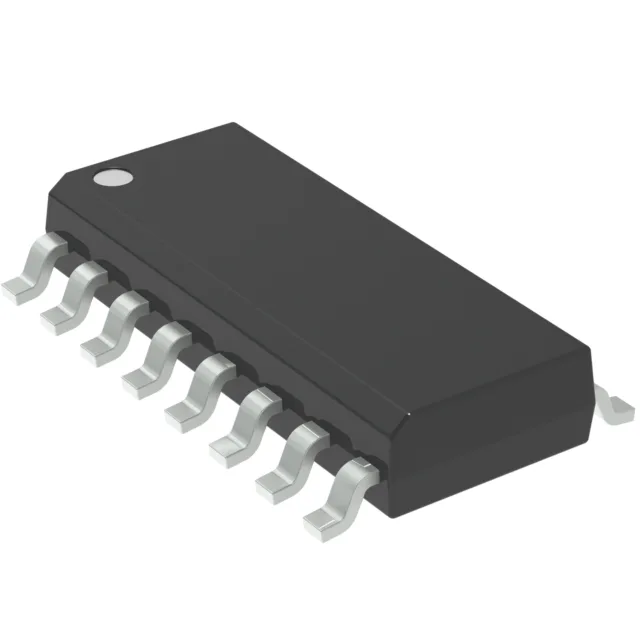
TL494CDR2G - onsemi
IC REG CTRLR BCK/PSH-PULL 16SOIC
Full Technical Specifications
17 Parameters| Parameter / Attribute | Specification / Value |
|---|---|
| Series | SWITCHMODE™ |
| Output type | Transistor Driver |
| Mounting | Surface Mount |
| Voltage - supply (Vcc (Vdd)) | 7V ~ 40V |
| Frequency - switching | 200kHz |
| I/O channels | 2 |
| Output phases | 1 |
| Duty cycle | 48% |
| Operating temperature | 0°C ~ 70°C (TA) |
| Package | Tape & Reel (TR) Cut Tape (CT) |
| Function | Step-Down, Step-Up/Step-Down |
| Topology | Buck, Push-Pull |
| Clock sync | No |
| Case | 16-SOIC (0.154\", 3.90mm Width) |
| Control features | Dead Time Control, Frequency Control |
| Output configuration | Positive |
| Synchronous rectifier | Yes |
Need Stock or a Drop-in Second-Source for TL494CDR2G?
Package: DIP-16 / SOIC-16 · Pin-compatible replacements with immediate Shenzhen spot stock
The TL494 is the PWM heart of classic ATX supplies, inverters, welders and battery chargers - a 16-pin voltage-mode controller whose real-world identity is a family: KA7500B, MB3759 and IR3M02 are pin-for-pin clones, and repair benches swap them daily. Two traps live here. The first is quality drift inside the clone family - the cheaper suffix revisions (7500C and similar) have documented poorer oscillator and drive behavior, and a supply that squeals under load after a cheap swap is the classic symptom. The second is the SG3525, a functionally similar controller that is not pin-compatible and keeps getting treated as one.
Verified Pin-Compatible Replacements (3 verified alternatives)
The Ubiquitous ATX Clone
Shenzhen Spot Stock (24-48h Dispatch)
Pin-for-pin equivalent of the TL494: same 5V reference, dual error amplifiers, dead-time comparator and dual output transistors - the part most ATX supplies were actually built with.
Same operating envelope as the TL494 (7V to 40V class supply, output stage per the datasheet).
The Japanese-Origin Equivalent
Shenzhen Spot Stock (24-48h Dispatch)
The Fujitsu TL494-equivalent of the same architecture era - same pinout and function, found in Japanese-built supplies of the 1980s-90s.
Same envelope as the family.
Same Job, Different Wiring - Do Not Plug In
Shenzhen Spot Stock (24-48h Dispatch)
A voltage-mode PWM controller with a similar mission (8V to 35V supply, 500kHz class, 5.1V reference) but a different internal design: single error amplifier, built-in soft-start and shutdown, totem-pole output stage instead of the TL494 open-collector/emitter transistors.
8V to 35V operating range; 5.1V reference against the TL494 5V.
Buyer & Quality Checklist for Sourcing Alternatives
- Clone quality is suffix-dependent: the KA7500B family is the safe interchange, while cheaper suffix revisions (7500C and no-name equivalents) report poorer oscillator accuracy and drive strength - a supply that squeals or drifts after a cheap swap is showing you the suffix.
- Pin 13 output-control and the dead-time pin define the topology behavior (push-pull versus single-ended, minimum gap): if a swapped-in part has "different dead-time curves" from the original, the symptom shows at light load.
- The TL494 error amplifiers are conventionally used with the reference on the non-inverting input and the sensed rail on the inverting input - the reverse of intuition. When touching the feedback network, read the schematic against the part, not against habit.
- One measurable cross-brand difference worth knowing: TL494 error-amp open-loop gain is specified around 70dB against about 65dB for the KA7500B. In most supplies this is invisible; in precision chargers, verify regulation after a brand swap.
- The SG3525 lives one shelf away and is not pin-compatible. If a repair needs its features (soft-start, totem-pole drive), the board has to change with it.
- Keep verified lots: the 16-pin PWM drawer is a classic relabeling target, and the failure mode (frequency drift) is invisible to DC tests.
Frequently Asked Technical Questions
Q: Is KA7500B the same as TL494?
A: Functionally and pin-for-pin, yes - it is the Fairchild-line clone that most ATX supplies were actually built with, and the standard repair interchange in both directions. For precision loops, note the small error-amplifier gain difference when cross-swapping brands.
Q: Can I replace a TL494 with an SG3525?
A: No. Similar job (voltage-mode PWM controller) and the same 16-pin body, but different pinout, different output stage and different support pins. It is a redesign part, not a repair substitution.
Q: Why does my power supply squeal after replacing the PWM chip?
A: Two usual causes: a cheaper clone suffix with poorer oscillator or drive behavior (the known 7500C-class issue), or a marginal compensation network reacting to the cross-brand gain difference. Fit a documented KA7500B/TL494-grade part and re-check the loop.