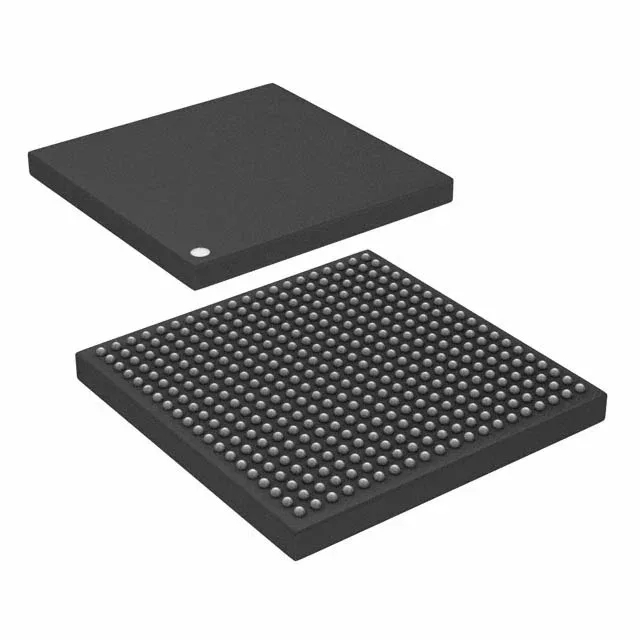
Memory interface — DDR2, LPDDR, LPDDR2
The MCIMX507CVM8B: The memory controller supports LPDDR, LPDDR2, and DDR2 — this gives the board designer a choice between low-power mobile memory (LPDDR2) and commodity DDR2, depending on the system cost and power target. The 800 MHz core clock and the memory controller's bus width set the throughput ceiling — a 32-bit DDR2 at 400 MHz delivers 3.2 GB/s, enough for a 1080p display buffer without external frame memory.
Peripheral set — USB and Ethernet on-chip
Two USB 2.0 ports with integrated PHY mean no external transceiver for host or device mode — the PHY's register map is part of the i.MX50 reference manual, and the Linux USB stack enumerates both ports on a standard BSP. A single 10/100 Mbps Ethernet MAC with on-chip PHY handles the wired network link — the RMII interface keeps the pin count low, but the board layout must keep the 50 MHz reference clock trace short and impedance-controlled. Additional interfaces include I2C, SPI, UART, SSI, I2S, AC'97, MMC/SD, and 1-Wire — enough serial buses to connect a touch controller, audio codec, Wi-Fi module, and SD card without an external expander.
Multimedia and graphics acceleration
The integrated LCD controller drives a direct panel interface — no external display bridge needed for parallel RGB panels up to WXGA (1366x768). Hardware graphics acceleration and a NEON SIMD coprocessor offload the Cortex-A8 core for 2D composition and signal-processing loops — the NEON unit handles 128-bit vector operations in a single cycle, which matters for real-time audio filtering or image pre-processing.
Security and boot protection
Boot Security, Cryptography, and Secure JTAG are listed — these features enable secure boot chain validation and debug port lockdown, which is required for payment terminal or medical device certification.
Supply voltage and temperature grade
The I/O voltage rails span 1.2 V, 1.875 V, 2.775 V, and 3.0 V — the core runs on a separate 1.2 V rail, while the DDR interface uses 1.875 V (LPDDR2) or 1.8 V (DDR2), and the general-purpose I/O bank runs at 3.0 V or 2.775 V.