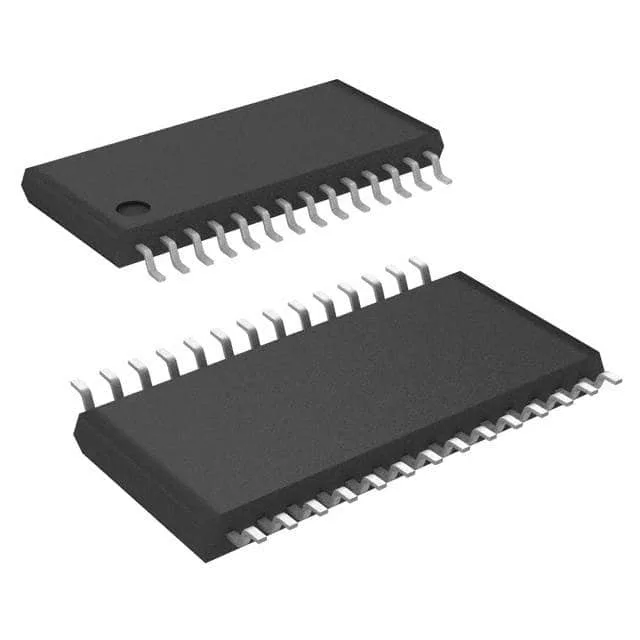
40 MHz S08 core with 16 KB on-chip Flash
The MC9S08SH16CTL: This sets the instruction throughput ceiling for the application; at 40 MHz the bus clock is typically half the core clock, so the effective memory-access rate is 20 MHz, which is the limiting factor for tight loop timing, not the CPU itself. Program memory is 16 KB of on-chip FLASH, organized as 16K x 8 bits. This is sufficient for a moderate-sized firmware image with a small RTOS or a bare-metal scheduler, plus a bootloader if the application needs field updates. The FLASH endurance is rated for the standard 100,000 write/erase cycles typical of this process node, which is adequate for most embedded control applications. The 1 KB (1K x 8) on-chip RAM is the tightest resource. Budget the stack, the HAL's global data, and the application heap against this 1024-byte ceiling. For a typical sensor-node firmware with a 128-byte stack and 256 bytes of global data, about 640 bytes remain for the application heap — enough for a few small buffers but not for large frame buffers or extensive DMA descriptors.
Wide supply range and industrial temperature grade
The internal oscillator is trimmed at the factory and maintains accuracy across this range without an external crystal.
On-chip peripherals reduce external BOM
Integrated peripherals include LVD (low-voltage detect), POR (power-on reset), a PWM module, and a watchdog timer. The LVD and POR together ensure the MCU resets cleanly on power-up and brown-out events without an external supervisor IC. The PWM module can drive a small DC motor or LED dimmer directly, though the I/O pin drive current is typically 5 mA per pin. The 16-channel, 10-bit ADC covers most analog sensor interfaces — temperature, pressure, potentiometer feedback — without an external ADC. The 10-bit resolution gives 1024 steps over the reference voltage; at a 5 V reference, that is about 4.88 mV per step, which is adequate for many industrial sensor outputs. Serial connectivity includes I²C, LINbus, SCI (UART), and SPI. This covers the common buses for sensor modules (I²C for temperature/humidity sensors, SPI for displays or external ADC), actuator communication (LIN for automotive sub-bus), and diagnostic links (SCI for RS-232 or RS-485 via an external transceiver). 23 general-purpose I/O pins in a 28-pin package is a high pin-to-package ratio. Most pins serve dual functions — a single pin may be a GPIO, an ADC input, and a serial interface pin. The pin mux must be configured carefully during firmware initialization to avoid conflicts.
Active production, ROHS3 compliant
The MSL (moisture sensitivity level) is typically MSL-1 for this package, but the actual level should be confirmed from the package marking. The footprint requires a 4-layer board for optimal decoupling and ground plane, though a 2-layer board is possible if the trace routing is carefully managed.