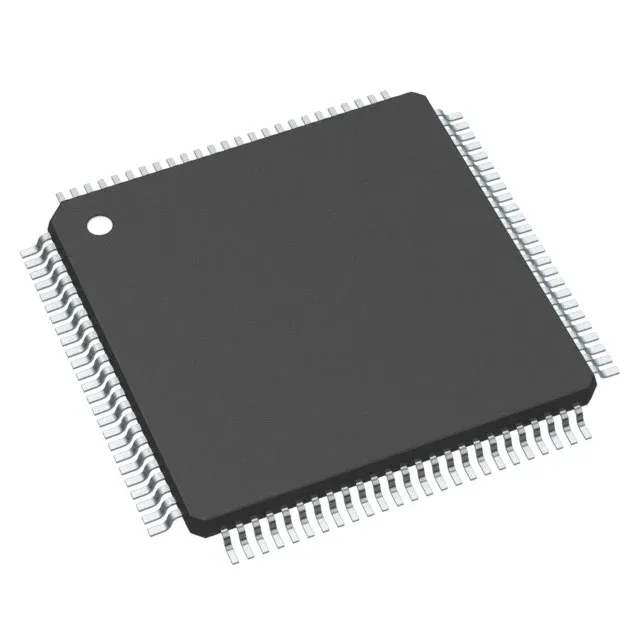
NXP USA Inc. LPC5512JBD100E — Microcontrollers & Processors (MCU / MPU / DSP)

NXP LPC5512JBD100E ARM Cortex-M33 MCU, 150MHz

MPNLPC5512JBD100E
Active

NXP LPC5512JBD100E, LPC551x series, ARM Cortex-M33 32-bit single-core MCU, 150MHz, 64KB Flash, 48KB RAM, CAN, USB OTG, Flexcomm, 10x16b SAR ADC, 1.8-3.6V, -40 to 105°C, 100-HLQFP exposed pad, tray.

$6.5800Ref. price · indicative, final on quote
Sourced new & surplus through independent channelsAuthenticity-screened · ESD-safe packingListing updated Jul 2026

Specifications

LPC5512JBD100E specifications
ParameterValue
SeriesLPC551x
MountingSurface Mount
Oscillator typeInternal
Program memory typeFLASH
Voltage - supply (Vcc (Vdd))1.8V ~ 3.6V
Operating temperature-40°C ~ 105°C (TA)
Speed150MHz
PackageTray
RAM size48K x 8
Core size32-Bit Single-Core
PeripheralsBrown-out Detect/Reset, DMA, I²S, POR, PWM, RNG, WDT
ConnectivityCANbus, Flexcomm, I²C, SPI, UART/USART, USB
Number of i (O)64
Core processorARM® Cortex®-M33
Case100-LQFP Exposed Pad
Data convertersA/D 10x16b SAR
Program memory size64KB (64K x 8)

Product details

Flexcomm and USB OTG — one serial peripheral, many protocols

The Flexcomm interface is the standout peripheral: each serial engine can be configured as SPI, I2C, or UART individually, so a single PCB layout covers multiple product variants without changing the MCU footprint. The USB OTG controller handles device, host, and dual-role operation — useful for a field-upgrade tool or a data-logger that plugs into a laptop. The 10-channel 16-bit SAR ADC samples at rates adequate for three-phase current sensing or multi-channel temperature monitoring. The on-chip DMA can shuttle ADC results directly to RAM without CPU intervention, keeping the M33 free for control loops.

Frequently asked questions

What is the operating temperature range of LPC5512JBD100E?

The operating temperature range is -40 to 105 °C, making it suitable for industrial and extended-temperature environments.

Does LPC5512JBD100E support USB OTG?

Yes, the connectivity block includes USB OTG alongside CAN, Flexcomm (SPI/I2C/UART), and standard serial interfaces.

What is the difference between LPC5512JBD100E and LPC5514JBD100?

The primary difference is Flash density: the LPC5512 carries 64 KB, while the LPC5514 doubles that to 128 KB. Both share the same 150 MHz Cortex-M33 core, 48 KB RAM, package, and peripheral set — the LPC5514 is the higher-density sibling for firmware that outgrows 64 KB.

Is LPC5512JBD100E a drop-in replacement for LPC54114?

No. The LPC54114 is a Cortex-M4/M0+ dual-core MCU in a different pinout and power architecture. The LPC5512JBD100E is a single-core M33 part and is not pin-compatible — a board redesign is required.