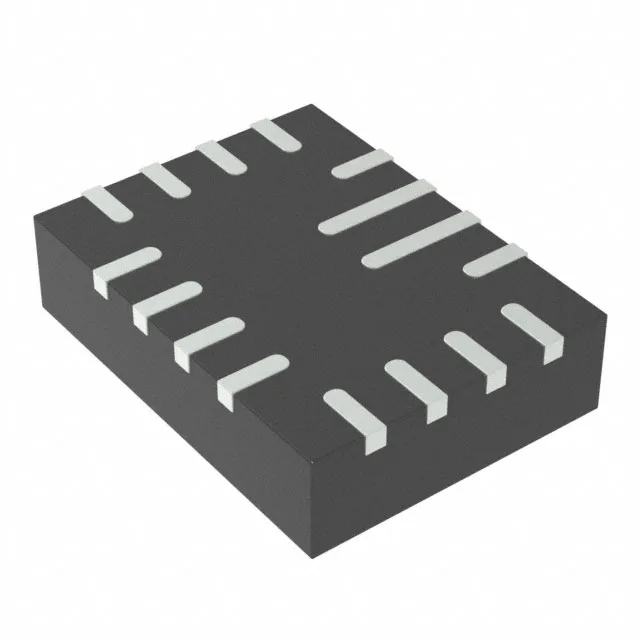
What the 36 V input rating means for automotive rails
The MPQ4430GL-AEC1-Z: The maximum input rating of 36 V sits comfortably above the 12 V and 24 V nominal rails found in passenger and commercial vehicles. Load-dump transients — the voltage spikes that appear when the alternator disconnects from a discharged battery — routinely exceed 30 V on a 12 V bus; the 36 V ceiling gives the headroom needed to survive those events without an external clamping network.
3.5 A output and the 0.8 V rail floor
Rated 3.5 A continuous output in a 16-PowerVQFN package, the regulator drives the load rails downstream without an external boost stage on most body control modules and ADAS ECU designs. The minimum output of 0.8 V covers the sub-1 V core voltages demanded by modern SoCs and microcontrollers — a single adaptive layout serves across multiple rail set-points.
Switching frequency and the non-synchronous constraint
Switching frequency is programmable from 350 kHz to 1.5 MHz from a single resistor, letting the designer trade efficiency against magnetics size. The device is non-synchronous — the freewheeling path runs through an external Schottky diode — so the diode selection directly affects conversion efficiency and thermal margin at high load current.
Junction temperature grade and the automotive envelope
AEC-Q100 qualification means the wafer and assembly have passed the temperature cycling, humidity bias, and electrostatic discharge screening required for safety-critical hardware.
QFN thermal pad — layout responsibility
The 16-PowerVQFN (3x4 mm) uses an exposed paddle as the primary thermal path to the board. theta-JA is set largely by the pad footprint and the copper plane area on the board — insufficient vias or undersized copper will push junction temperature above the 125 °C limit before the rated 3.5 A is reached. The thermal pad must be soldered across its full area, not just pinned at the corners.