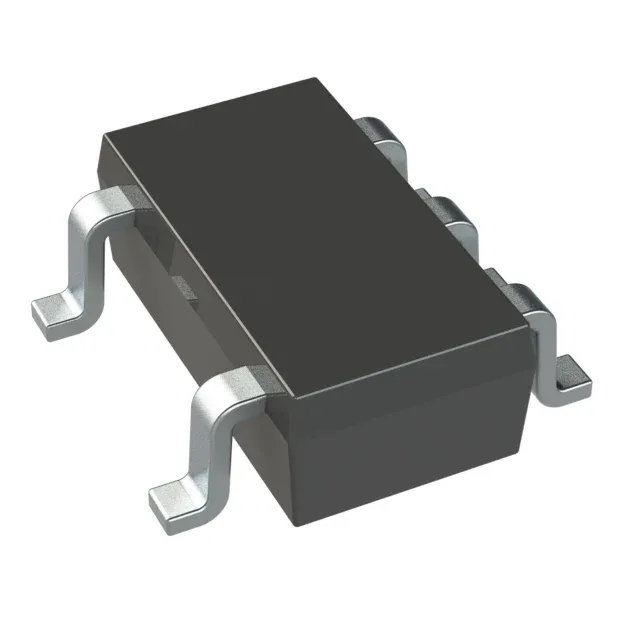
The Microchip MCP4014T-103E/OT is a single-channel, volatile digital potentiometer (rheostat configuration) with a 10 kΩ end-to-end resistance and 64 wiper taps, arranged in a linear taper. The 64 taps give a resolution of about 158 Ω per step, which is fine enough for trimming bias voltages, setting comparator thresholds, or calibrating sensor offsets in a production line. The linear taper means the resistance changes uniformly with the tap position — no log or audio curve — so it is a straight choice for DC level-setting, not volume control.
Supply and temperature range — where it lives
The 150 ppm/°C temperature coefficient on the resistor string means the 10 kΩ end-to-end value drifts about 1.5 Ω per degree — negligible for most trimming applications, but worth noting if the set point needs to hold across the full temperature sweep without recalibration.
Interface and control — Up/Down with chip select
The MCP4014 uses a simple Up/Down (U/D, CS) serial interface rather than I²C or SPI. Two digital lines — chip select (CS) and up/down (U/D) — control the wiper position: pulling CS low and toggling U/D steps the wiper up or down one tap per pulse. This is a minimalist control scheme that frees up I²C/SPI bus resources and works well with a couple of spare GPIOs from an MCU. The wiper resistance is 70 Ω typical, which adds a small series resistance that matters only in very low-impedance divider networks.
Package and footprint — SOT-23-5
Housed in a 5-lead SOT-23 (SC-74A, SOT-753) surface-mount package, the part occupies minimal board area — about 3 mm × 3 mm. The SOT-23-5 footprint is standard and easy to route; the small size suits dense designs like sensor modules, handheld instruments, and compact power supplies.
It is ROHS3 compliant, with no lead, mercury, cadmium, or other restricted substances above the threshold.