150 mA fixed 1.8 V rail for sensor and MCU supplies
The MCP1801T-1802I/OT is a fixed-output 1.8 V LDO from Microchip Technology, delivering 150 mA continuous current from a 10 V max input rail. That 150 mA ceiling covers a small MCU, a Bluetooth module, or an op-amp chain — anything that draws under 120 mA leaves headroom for the LDO to regulate cleanly without dropping out. Quiescent current sits at 50 µA typical, so the regulator's own draw is low enough for battery-powered gear that spends most of its time in sleep mode. The enable pin lets a microcontroller or a power-management IC shut the rail entirely, pulling Iq to near zero between active bursts.
PSRR and noise rejection on the 1.8 V analog rail
Power-supply rejection ratio is 70 dB at 10 kHz — that is roughly a 3000:1 attenuation of ripple from a switching pre-regulator. For a 1.8 V rail feeding an ADC reference or a sensitive analog front-end, this keeps the switching noise from coupling into the signal path. Below 10 kHz the rejection is even higher, so 100/120 Hz mains ripple is essentially invisible at the output. The output is fixed at 1.8 V with ±2% typical accuracy — no external resistor divider needed. Over-current protection is built in; if the load pulls above the limit, the output folds back rather than latching off, so a brief surge on startup does not lock the rail.
SOT-23-5 footprint and field-swap reality
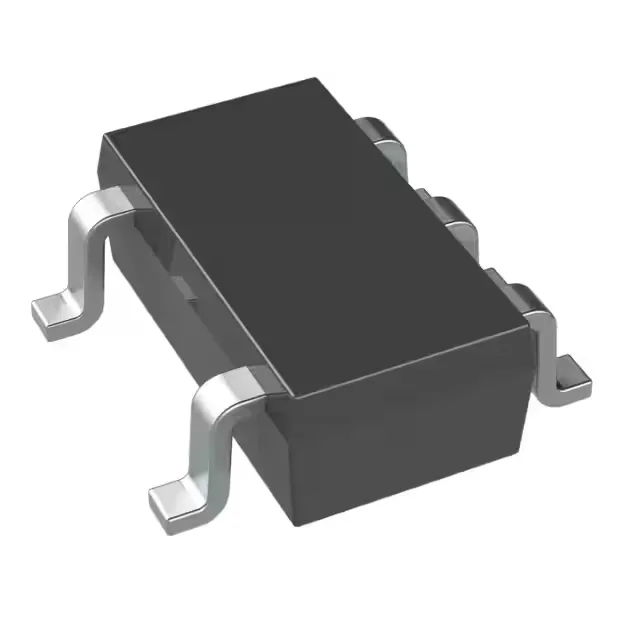
Housed in a 5-lead SOT-23 (SC-74A), the MCP1801T-1802I/OT takes up about 3 mm × 3 mm of board space. Pin 1 is marked with a dot on the top — orientation is obvious under magnification, and with a fine-tip iron and tweezers you can swap it on site without a hot-air station. The enable pin is active-high; leave it tied to the input if you do not need the shutdown function. The input capacitor and output capacitor are not specified in this listing — typical LDO practice is 1 µF ceramic on each pin, placed close to the package.
Active production and compliance
It is ROHS3 compliant, so it ships into RoHS-regulated markets without exemption paperwork. The tape-and-reel option suits automated pick-and-place; cut tape is also available for prototype runs.