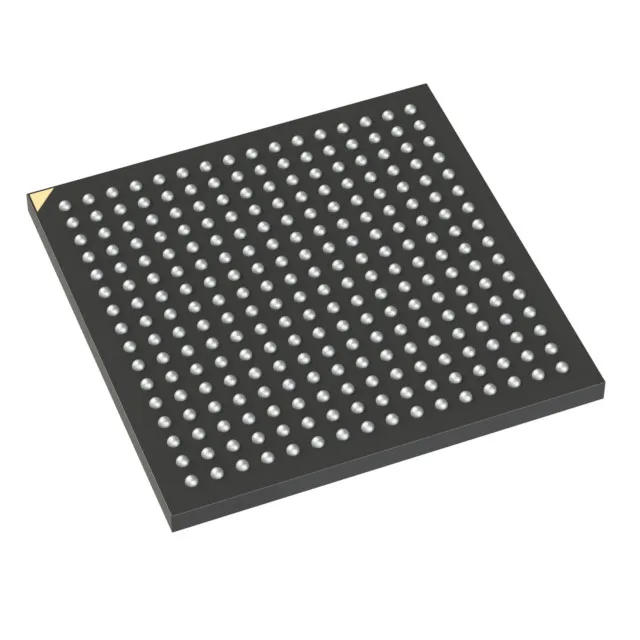
44K LUTs in a 14x14 mm BGA — logic density vs footprint trade-off
The LFE5U-45F-7BG256I packs 44,000 logic cells across 11,000 LABs into a 256-ball CABGA measuring 14x14 mm. That is a dense slice of the ECP5 family — the same logic fabric as the larger 381-ball sibling but in a package that saves about 30% board area. For a design that needs 44K LUTs and can route within 197 I/O, this is the smallest physical envelope Lattice offers at this density.
197 user I/O — what the ball map gives up
With 197 I/O on a 256-ball array, roughly 77% of the balls are signal — the rest are power, ground, and configuration pins. That is a high signal-to-ball ratio: the 59 non-I/O balls must supply the core at 1.045-1.155V and the I/O banks, so the PCB power-plane design needs to handle the current draw through a limited number of VCC and GND balls. The 14x14 mm body means the BGA pitch is 0.80 mm, which routes cleanly on a 4-layer board with 0.15 mm trace/space. The 1.9 Mbit embedded block RAM is distributed across the LAB array as 36 Kbit blocks. For a 44K LUT design, the RAM-to-logic ratio is about 43 bits per LUT — enough for small FIFOs, line buffers, or register files without bolting on external SRAM. Above that, the 197 I/O can interface to a parallel NOR flash or DDR memory on the same board.
Industrial temperature grade — junction limits and thermal management
In a sealed enclosure with no airflow, the 14x14 mm BGA's thermal resistance (θJA around 25-30°C/W typical for a 256-ball CABGA) means a 1.5W core power draw raises the junction 37-45°C above ambient. At 85°C ambient, the junction hits 122-130°C — above the 100°C limit. So this part needs either a heatsink, forced air, or a derated logic utilization to stay inside the TJ envelope at the high end of the industrial range.