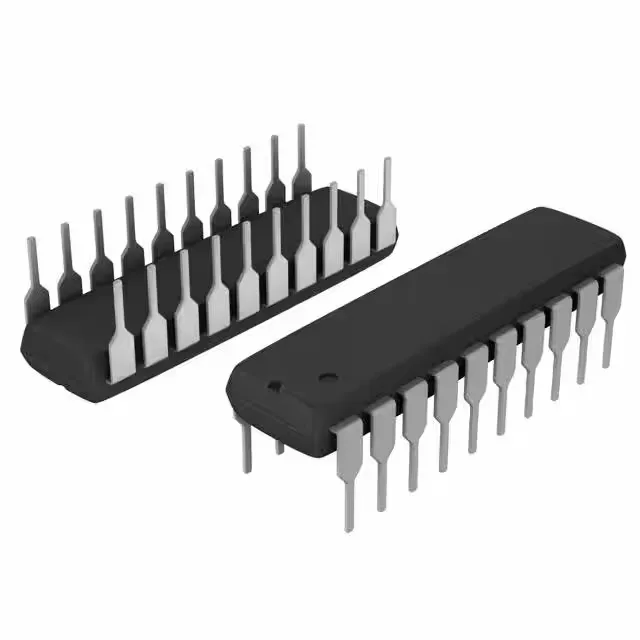
25 ns speed grade — where it matters in the logic path
The GAL16V8D-25QP: The 25 ns max propagation delay (tpd) sets the ceiling for registered output toggling and combinatorial decode paths. In a 5 V address decoder or state machine running at 40 MHz, this part keeps combinatorial delays under one clock cycle — but the 25 ns figure is the pin-to-pin delay through the logic array, not the internal register toggle rate, so the usable system clock is lower than the reciprocal of tpd suggests. Eight macrocells means this part consolidates roughly 20–30 discrete 74-series logic gates into one DIP — enough for a bus interface, a simple sequencer, or a memory-mapped I/O decoder. The EE PLD architecture is in-system reprogrammable, not OTP, so the same socket can be updated during board bring-up without swapping parts.
5 V supply rail — legacy system fit
The 20-pin DIP footprint (0.300-inch row spacing) is a legacy through-hole package that mates with standard wire-wrap or soldered sockets; any pin-compatible replacement must share the same 20-DIP mechanical outline and 5 V supply. Commercial temperature range 0°C to 75°C limits deployment to indoor, temperature-controlled environments — no extended industrial or automotive margin. The bulk packaging means parts are tube- or tray-shipped, not tape-and-reel, so pick-and-place requires a tube feeder or manual insertion.