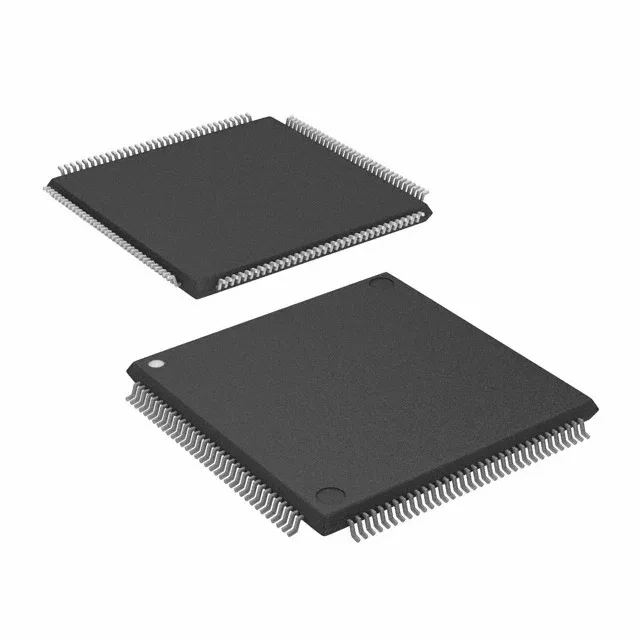
What this CPLD brings to the board
The Intel EPM570T144I5 is a MAX II family CPLD with 570 logic elements and 440 macrocells in a 144-LQFP package. The 5.4 ns pin-to-pin delay (tpd) handles address decoding and bus bridging. In-system programmable via JTAG — no socket, no UV eraser, just a programmer cable during board test. No commercial-grade limitations here — this part is rated for the panel, not the office.
Density and speed — the fit decision
570 logic elements and 440 macrocells is the mid-density sweet spot in MAX II. It replaces multiple 128-macrocell MAX 7000 parts (like the EPM7128 series) on a single chip, with a faster 5.4 ns tpd versus 5–7.5 ns on those older families. The trade-off: you get more routing flexibility and lower dynamic power than MAX 7000, but the instant-on characteristic is the same — no configuration memory to load, the design runs from the first clock edge. If your design needs more than 116 I/O or beyond 570 LEs, step up to a higher-density MAX II device — same toolchain, same package footprint options, just bigger die.
No last-time-buy notice, no EOL risk on the horizon. It is still supported by Intel's Quartus Prime design software and remains a valid choice for new production builds — not a legacy part you are forced to stockpile. For dual-source resilience: the MAX II family has no pin-compatible second source from another manufacturer. If you need a backup, Intel's own commercial-temperature sibling shares the same die and package but lacks the industrial range. Stick with the I5 for -40 to 100 °C applications.
Package and integration notes
144-LQFP, 20x20 mm body. Surface-mount only — no through-hole variant. The 116 I/O lines require careful PCB routing.