What the 440 macrocells and 5.4 ns tpd mean for your design
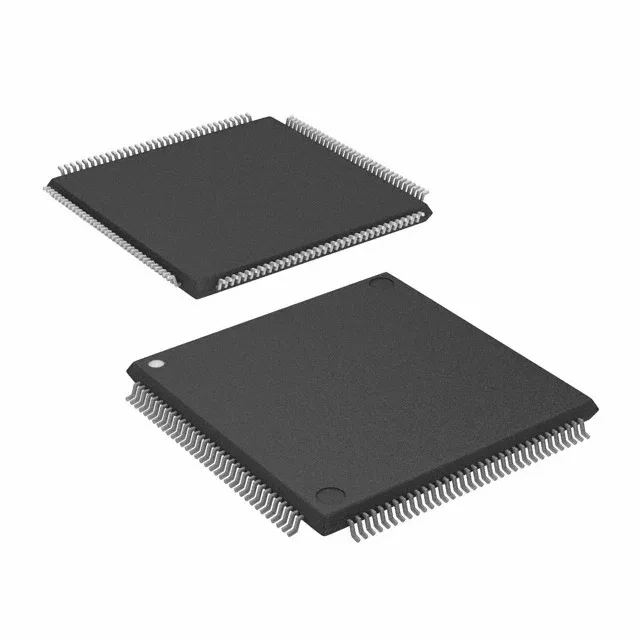
The EPM570GT144I5N is a MAX® II CPLD from Intel, packing 440 macrocells into a 144-TQFP package. That macrocell count places it in the mid-range of the MAX II family — enough for glue logic, address decoding, state machines, or a small microcontroller peripheral bus without needing a larger FPGA. The 5.4 ns propagation delay (tpd1 max) means combinatorial logic paths settle within that window, so the part can handle 100+ MHz clock domain crossings when the input setup time is budgeted correctly. For a 50 MHz system clock, the tpd leaves about 15 ns of slack after the clock-to-output of the driving flip-flop. With 116 I/O pins available, you can interface to a 16-bit data bus plus address lines and control signals, or connect to a parallel LCD, SRAM, and a handful of sensors — all without multiplexing the pins.
Temperature grade and supply voltage — industrial deployment
Core voltage is 1.71 V to 1.89 V, which means a 1.8 V rail with ±5% tolerance keeps the part in spec.
In-system programmability and package
The EPM570GT144I5N is in-system programmable via JTAG, so you can update the logic on the assembled board without removing the part. The 144-TQFP (20x20 mm) is a hand-solderable fine-pitch package — 0.5 mm lead pitch — common in mixed-signal boards where a BGA would complicate the routing.