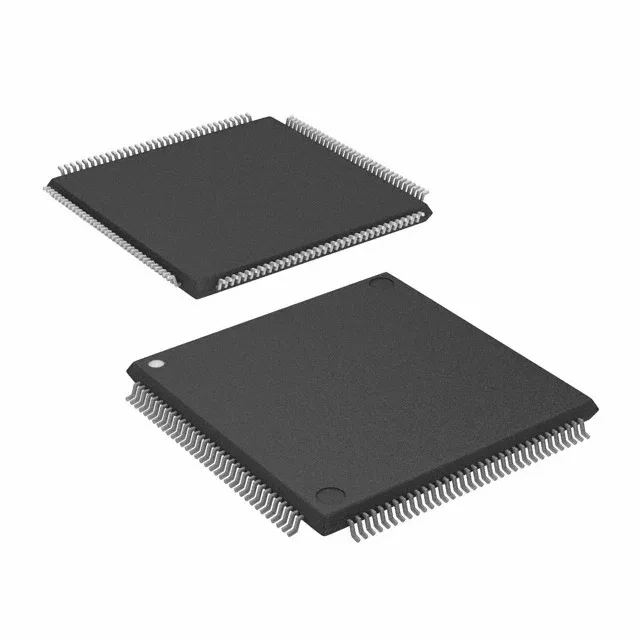
440-macrocell CPLD with 5.4 ns pin-to-pin delay
The Intel EPM570GT144C4N is a MAX® II family CPLD offering 440 macrocells and 570 logic elements in a 144-LQFP package. The 5.4 ns maximum pin-to-pin delay (tpd1) sets the combinatorial logic speed ceiling — signals propagating through a single LUT level settle within this window, which matters for address decoding or fast control-path gating where the downstream register setup time must be met. With 116 user I/O, this part suits glue-logic consolidation in systems that need moderate density — think bus interfacing, state-machine control, or replacing multiple 7400-series logic devices on a single board.
Core voltage is 1.71 V to 1.89 V, a narrow 1.8 V nominal rail that demands a clean supply — a standard 1.8 V LDO with 50 mV ripple is adequate, but the decoupling network should follow the layout guidelines in the MAX II handbook to keep core noise below the threshold that could corrupt the internal configuration SRAM. For extended industrial or automotive temperature, a different temperature-suffix variant would be required.
In-system programmability and programmer compatibility
The EPM570GT144C4N is in-system programmable via the JTAG interface (IEEE 1149.1). Any standard JTAG cable supporting Altera/Intel CPLDs — such as the USB-Blaster II or ByteBlaster II — can program it. No dedicated high-voltage programmer is needed; the core voltage supplies the programming logic.