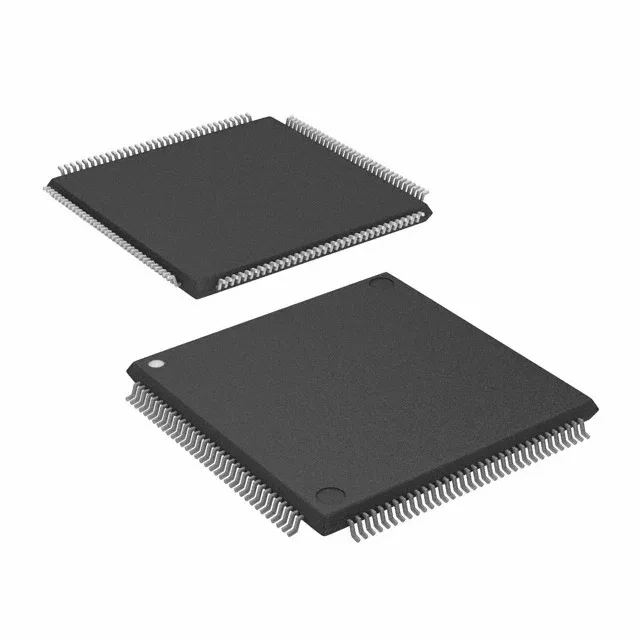
Active production — no allocation pressure on this MAX II CPLD
The EPM1270T144C5N: Where is it in the cycle? Still in the middle of its production run. The MAX II family is mature but not retired, so the spot premium over franchised price stays thin unless a wider CPLD shortage tightens supply across all densities.
Logic density and speed — where the 6.2 ns tpd sets the ceiling
1270 logic elements and 980 macrocells give this CPLD enough fabric to absorb a handful of 8-bit address decoders, state machines, and bus-interface glue without needing a larger FPGA — the 116 user I/O in the 144-LQFP package is the pin-limited bottleneck, not the logic. The 6.2 ns tpd(1) max is the combinatorial propagation delay from any input through one level of logic to any output — at this speed grade (C5) the part can latch a 50 MHz bus without violating setup/hold on the downstream device, but the pin-to-pin delay through two macrocell levels stacks to roughly 12.4 ns and eats into the timing budget for multi-level decode paths.
In-system programmability and package rework
In-system programmable via JTAG — the part arrives blank and gets configured on the board after reflow, so there is no pre-programming inventory split and no socket burn-in step. The 144-TQFP (20x20) package has a 0.5 mm pitch — reworkable with a standard hot-air nozzle and no BGA underfill.