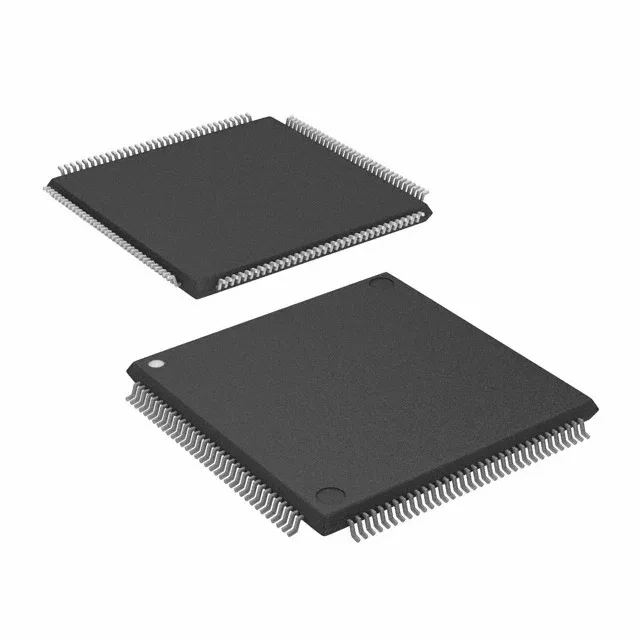
980-macrocell CPLD with 6.2 ns pin-to-pin delay
The Intel EPM1270T144A5N is a MAX II family CPLD packing 980 macrocells and 1270 logic elements in a 144-TQFP package. The 6.2 ns maximum propagation delay (tpd1) means combinatorial logic paths settle within one fast clock cycle — the limiting factor for address decoding or glue logic in a 100 MHz+ system is this delay, not the core speed. With 116 user I/O pins, this part handles wide data buses or parallel interfaces without needing an external port expander. The I/O count is the practical ceiling for a single-chip CPLD solution in a 144-pin footprint.
Industrial temperature grade and dual-voltage supply
A design using 3.3 V I/O with a 2.5 V core saves about 15% dynamic power versus a full 3.3 V core. In-system programmable via JTAG, the EPM1270T144A5N can be reprogrammed on the assembled board without a separate programmer — useful for field updates or last-minute logic tweaks during production ramp.
Package and board-fit note for the 144-TQFP
Housed in a 144-lead LQFP (supplier package 144-TQFP, 20x20 mm body), the 0.5 mm pitch demands a controlled-impedance stack-up for the outer rows. Supplied in tray format — the parts are loose in the tray wells, not tape-and-reel. For automated pick-and-place, a tray feeder or a transfer to tape is required. Store the trays in a dry cabinet if the ambient humidity exceeds 60% RH; the MSL level is not stated but typical for this package class is MSL 3 (168-hour floor life).
Active lifecycle — no obsolescence concern
No official successor or replacement is listed — the MAX II family continues as Intel's mainstream low-density CPLD line. The base product number EPM1270 is the same across speed and temperature variants; the suffix A5N denotes the industrial temperature grade and lead-free finish.