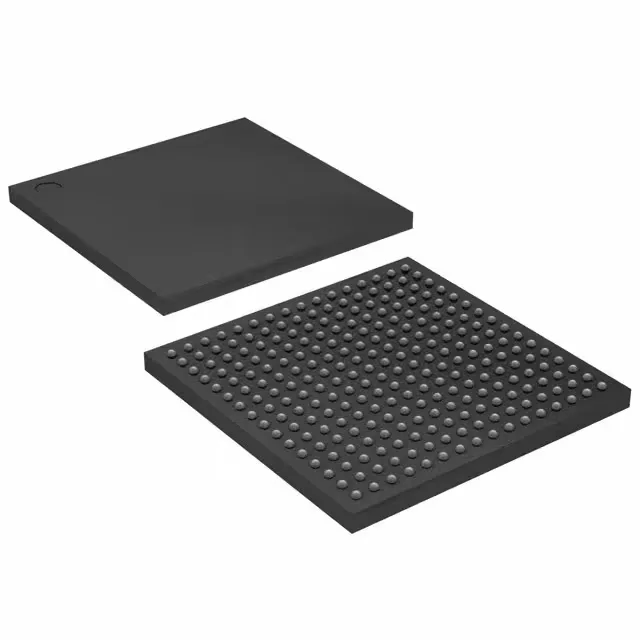
980 macrocells at 6.2 ns — where this CPLD fits
The EPM1270GF256C4 is a MAX® II CPLD from Intel, packing 980 macrocells with a propagation delay of 6.2 ns max. That delay means combinatorial logic paths settle within one 160 MHz clock period — fast enough for address decoding, bus bridging, or glue logic in a 100 MHz system without extra pipeline stages. With 212 user I/O and 1270 logic elements, this part sits above the small CPLDs (like the 128-macrocell MAX 7000 series) and into the territory where you might choose it over a small FPGA if instant-on, single-chip configuration, and deterministic timing matter more than gate count.
The core runs from 1.71 V to 1.89 V, a tight 1.8 V nominal rail. The I/O banks are not listed with a separate voltage here, but the 212 I/O on a 256-ball BGA means many of those balls are supply or ground — plan for at least four decoupling caps per side on a four-layer board. Not suitable for outdoor enclosures without active cooling, but fine in a controlled lab or indoor panel environment.
256-FBGA footprint and board integration
Housed in a 256-ball FBGA, 17 mm square with 1.0 mm ball pitch. The 0.50 mm ball diameter means the escape via is a 0.30 mm finished hole with a 0.45 mm pad — standard for a four-layer board. The centre of the package has no thermal pad; heat dissipates through the balls into the PCB copper. Surface-mount only, shipped in trays. The in-system programmability (ISP) means you can reflash it on the board via JTAG after assembly — no socket needed.
Active production — sourcing posture
This is a current-production part, not a last-time-buy or obsolete line.