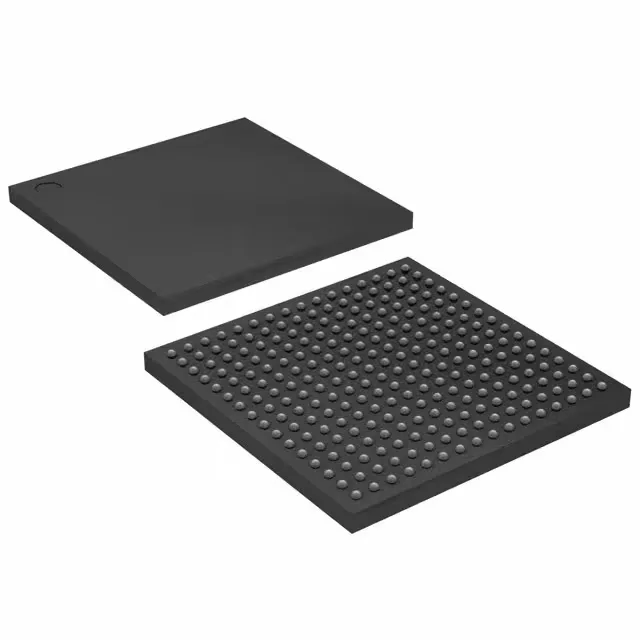
Logic capacity and speed grade for glue-logic consolidation
The Intel EPM1270GF256C3 is a MAX II CPLD with 980 macrocells and 1270 logic elements — enough to absorb a handful of 74-series glue-logic devices or a small state machine into a single programmable part. The 6.2 ns tpd(1) max propagation delay means combinatorial paths settle within one clock cycle at moderate speeds, suitable for bus decoding, address mapping, or control logic in a 50–100 MHz system. The 212 user I/O pins, spread across a 256-ball FBGA (17x17 mm), give plenty of headroom for connecting to a wide memory bus, multiple peripheral interfaces, or a large number of panel indicators and pushbuttons. The 1.71 V to 1.89 V core supply keeps dynamic power low, and the in-system programmable (ISP) flash allows reconfiguration without removing the part from the board.
Package and board integration for the 256-FBGA
The 256-ball FBGA (17x17 mm) with 1.0 mm ball pitch is a hand-solderable challenge — a rework station with a hot-air nozzle matched to the package footprint and a stencil for the BGA land pattern are the practical minimum. The 0°C to 85°C junction temperature range covers most indoor and telecom equipment environments but not extended industrial or automotive under-hood duty. The tray packaging means the parts arrive in a rigid carrier, not tape-and-reel — fine for prototype builds and low-volume production but worth noting for automated pick-and-place lines that expect embossed tape. The 256-FBGA has no exposed thermal pad; heat removal relies on the PCB copper planes under the BGA balls and any airflow across the package.