Logic capacity and timing margin
The EPM1270F256C3N belongs to the MAX® II family, Intel's low-power instant-on CPLD architecture. It integrates 1270 logic elements configured as 980 macrocells, giving it the density for medium-scale glue logic, address decoding, or peripheral control without the configuration latency of an FPGA. Maximum propagation delay tpd(1) is 6.2 ns, which sets the combinatorial path ceiling from any input to any output. For a 50 MHz bus interface, this leaves roughly 14 ns of cycle time after tpd — enough margin for setup and hold at the downstream register, but a 100 MHz interface would require pipelining or a faster CPLD.
I/O count and BGA footprint
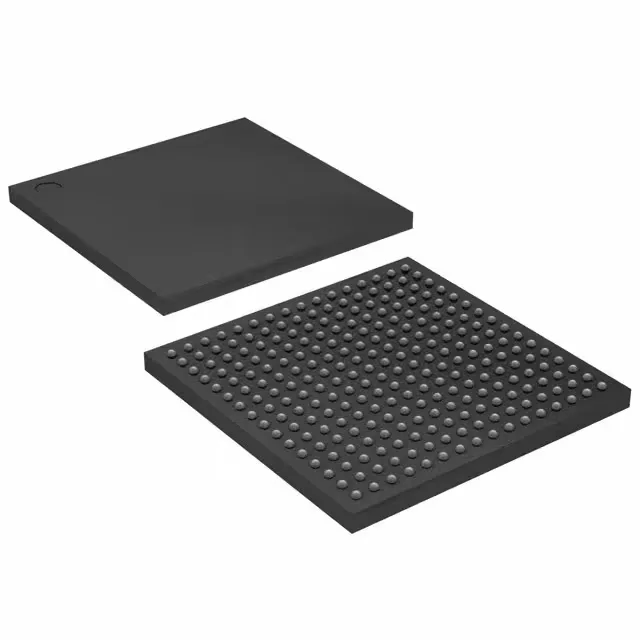
212 user I/O pins route through a 256-ball FBGA package measuring 17x17 mm.
Supply rails and in-system programming
The core logic runs at the lower rail to cut dynamic power; the I/O banks can operate at either voltage depending on the interface standard. In-system programmable via JTAG — no external programmer voltage is needed, and the non-volatile configuration holds through power cycles without a configuration PROM.
This is the commercial-industrial overlap band — suitable for telecom equipment in a climate-controlled shelter, factory-floor controllers with forced air, or outdoor enclosures that stay above freezing. Not qualified for the -40°C cold crank or 125°C under-hood environment; those would require the industrial-grade suffix variant.
Intel lists the EPM1270F256C3N as Active.