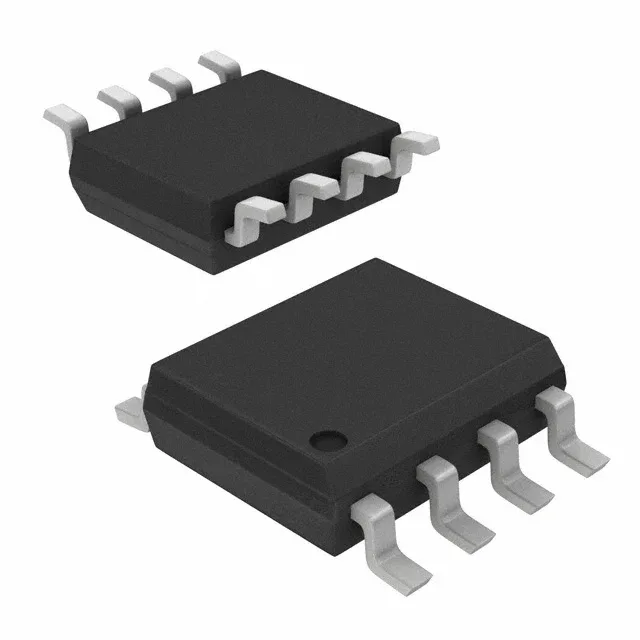
NE555S-13 Diodes Inc 555 Timer 500kHz 8-SOIC
IC OSC SINGLE TIMER 500KHZ 8SO
Full Technical Specifications
8 Parameters| Parameter / Attribute | Specification / Value |
|---|---|
| Type | 555 Type, Timer/Oscillator (Single) |
| Mounting | Surface Mount |
| Supply voltage | 4.5V ~ 16V |
| Current - supply | 13 mA |
| Frequency | 500kHz |
| Operating temperature | 0°C ~ 70°C |
| Package | Tape & Reel (TR); Cut Tape (CT) |
| Case | 8-SOIC (0.154\", 3.90mm Width) |
Need Stock or a Drop-in Second-Source for NE555S-13?
Package: DIP-8 / SOIC-8 · Pin-compatible replacements with immediate Shenzhen spot stock
Fifty years after introduction the 555 is still designed in, still taught, and still repaired. The bipolar NE555 remains in mass production across several fabs, so availability is not the issue. The two things that matter are the bipolar-versus-CMOS family boundary - the pinout survives the crossing but the output drive does not - and sourcing lots whose timing and temperature specifications are real; the 555 is a favorite of low-grade clones where timing accuracy is the first spec quietly loosened.
Verified Pin-Compatible Replacements (4 verified alternatives)
Direct House Second Source
Shenzhen Spot Stock (24-48h Dispatch)
The TI second source of the bipolar 555: same function table, same timing equations (monostable 1.1RC, astable 1.44 / ((R1 + 2R2) C)), supply 4.5V to 16V.
4.5V to 16V; output sinks and sources up to 200mA class; quiescent current milliamps class with the classic crowbar spike at output transitions.
Same Die, Surface-Mount Body
Shenzhen Spot Stock (24-48h Dispatch)
The SMD version of the NE555 in SOIC-8 - identical electrical behavior to the DIP-8 part.
4.5V to 16V; 200mA class output drive, both directions.
CMOS Modernization - Lower Power, Rail-to-Rail Output
Shenzhen Spot Stock (24-48h Dispatch)
CMOS 555: supply 2V to 15V, quiescent current in the hundreds of microamps against roughly 10mA for the bipolar part, no output crowbar current spike at transitions.
2V to 15V; output drive is asymmetric on CMOS: roughly 100mA sink but only about 10mA source typical - far below the bipolar 200mA both ways.
Low-Power CMOS Option with Wide Supply Range
Shenzhen Spot Stock (24-48h Dispatch)
The classic CMOS 555 from the Intersil / Maxim lineage: same timer function, microamp-class quiescent current, no crowbar spike.
Typical 2V to 18V supply window (check the specific vendor datasheet); output drive well below the bipolar 200mA class.
Buyer & Quality Checklist for Sourcing Alternatives
- Substituting bipolar to CMOS (TLC555 / ICM7555 / LMC555) keeps the pinout but changes drive: the bipolar part sinks and sources about 200mA, CMOS versions far less - and asymmetrically (strong sink, weak source). Re-check every output load.
- The bipolar 555 draws a large crowbar current spike during output transitions; circuits that were tuned around it (seen in some RF and audio designs) change character with a CMOS swap. Decouple the supply pin close to the package in all cases.
- Timing accuracy depends on internal comparator thresholds, not on external RC precision alone. For any timer that leaves the bench, measure the assembled frequency rather than trusting the calculator number - especially across CMOS and bipolar families, whose thresholds differ.
- Watch for relabeled or re-died 555 lots: cheap parts can pass DC tests and fail the timing drift or temperature specifications that the original design assumed.
- The control-voltage pin (CTRL, pin 5) is often left open on purpose; if the original design fitted a decoupling capacitor there, keep it - it is part of the timing stability, not decoration.
Frequently Asked Technical Questions
Q: Are all 555 timers interchangeable?
A: Within the bipolar family (NE555, LM555, MC1455, NE555D) yes - identical function and pinout. CMOS versions (TLC555, ICM7555, LMC555) share the pinout but differ in supply range, quiescent current and output drive; check the load before dropping one in.
Q: Can a CMOS 555 replace a NE555 in a relay driver?
A: Usually not directly: the bipolar NE555 sources and sinks up to about 200mA, while CMOS timers source far less (their sink capability is much stronger than source). Either keep a bipolar part or add a driver transistor for the relay.
Q: What is the difference between NE555 and SE555?
A: Same function; the SE prefix is the full military-temperature grade with tighter specifications. An SE555 works wherever an NE555 does; the reverse trades away temperature margin. Commercial NE555s are typically rated 0 to +70 degC, SE555 parts up to +125 degC.