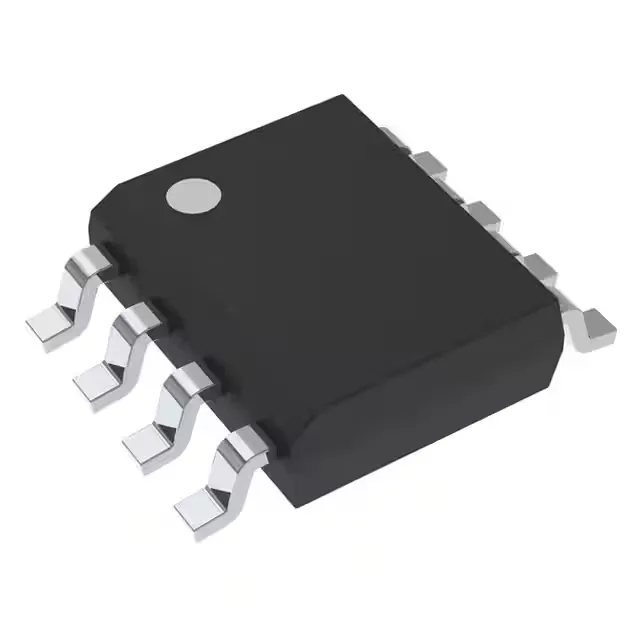
Catalyst Semiconductor Inc. CAT24C16WGE
IC EEPROM 16KBIT I2C 8SOIC
Full Technical Specifications
14 Parameters| Parameter / Attribute | Specification / Value |
|---|---|
| Memory type | Non-Volatile |
| Mounting | Surface Mount |
| Supply voltage | 1.7V ~ 5.5V |
| Clock frequency | 400 kHz |
| Memory interface | I²C |
| Operating temperature | -40°C~125°C(TA) |
| Package | Bulk |
| Technology | EEPROM |
| Access time | 900 ns |
| Memory size | 16Kbit |
| Memory format | EEPROM |
| Case | 8-SOIC (0.154\", 3.90mm Width) |
| Memory organization | 2K x 8 |
| Write cycle time - word, page | 5ms |
Need Stock or a Drop-in Second-Source for CAT24C16WGE?
Package: DIP-8 / SOIC-8 / TSSOP-8 · Pin-compatible replacements with immediate Shenzhen spot stock
The 24Cxx row is the settings, calibration and counter memory of a generation of instruments, monitors, meters and chargers: a 2-wire serial EEPROM whose 8-pin footprint never changes from 24C02 to 24C64, and whose address pins A0, A1 and A2 change MEANING at almost every density step. The base device address is always the industry-standard 1010 pattern, the SDA/SCL bus is open-drain with pull-ups, and the WP pin guards the array - and the substitutions that fail are almost never electrical: they are firmware assumptions about word addressing, or a cascade of devices whose address pins just became memory address bits.
Verified Pin-Compatible Replacements (3 verified alternatives)
The Density Ladder and the Address Pins
Shenzhen Spot Stock (24-48h Dispatch)
The same footprint four steps up: while 24C02 uses A0-A2 for hardware addressing (eight devices per bus), 24C04 drops A0, 24C08 drops two of them, and 24C16 repurposes all three as high-order memory address bits - one device per bus.
Identical 1.8-5.5V class envelopes across the row.
The Two-Byte Address Boundary
Shenzhen Spot Stock (24-48h Dispatch)
Beyond 2K bits the family changes address protocol: the word address becomes two bytes - and the address pins return to hardware duty (A0-A2 useful again for up to eight devices).
Same bus; the change is in the byte sequence, not the volts.
The Second-Source Shelf
Shenzhen Spot Stock (24-48h Dispatch)
The family was designed as an industry standard: the same 1010 device address, the same pin map, the same bus behavior under every vendor prefix - the reason a 24Cxx is a specification as much as a part number.
Minor differences live in the margins of the datasheets (timing at the fast modes, internal write cycle specifics) - the standard behaviors are common.
Buyer & Quality Checklist for Sourcing Alternatives
- The pin map is eternal: 1-3 A0/A1/A2, 4 GND, 5 SDA, 6 SCL, 7 WP, 8 VCC across every density - the family promise that hides the real variable: what A0-A2 mean at this density.
- Address-pin roles by density: 24C02 uses all three (eight devices per bus); 24C04 drops A0; 24C08 keeps only A2; 24C16 uses none (they become address bits); 24C32/64 bring them back. Density upgrades can silently break a multi-device cascade.
- The 256-byte address boundary: 24C02 through 24C16 differ in word-address width, and 24C32 and up change to a two-byte word address - firmware written around one convention misreads after the density step.
- Open-drain discipline: SDA and SCL need pull-ups (about 10k is the bench default) - a freshly wired or repaired bus without them is the classic intermittent EEPROM that works on the scope and fails in the field.
- The WP pin is a live design decision: tied low writes freely, tied high locks the array - and designs differ in whether WP floats to an internal state. The "will not save settings" repair starts with WP, then the bus, then the chip.
- The family is a standard, not a brand: 1010 is the base address under every prefix - buy the density and package against the schematic, and keep the suffix conventions (speed grade, temperature) of the original where the design specified them.
Frequently Asked Technical Questions
Q: Are 24C02 and 24C16 interchangeable?
A: Same 8-pin footprint and bus; different addressing. On the 24C16 the A0-A2 pins are memory address bits rather than hardware address pins, so a single-chip use in the low address space is largely transparent (firmware permitting), while a cascade that separated devices by address pins stops being a cascade.
Q: Can I use a 24C32 instead of a 24C02?
A: The footprint fits, but the protocol changes: 24C32 and up use a two-byte word address, and the A0-A2 pins return to hardware addressing duty. Firmware that assumed the 24C02 sequence must be updated before the density upgrade is real.
Q: Why does my EEPROM stop saving settings after a replacement?
A: In order: the WP pin is not in the state the design expects, the SDA/SCL pull-ups are missing or too weak, or the fitted density changed the addressing convention. The memory itself is the last suspect - and the easiest to test by reading back a known cell.