What the automotive AEC-Q101 grade means for your BOM
The 1.5SMC18A-Q carries AEC-Q101 qualification, which is the automotive discrete semiconductor stress-test standard. This means the part has passed the full suite of reliability screens — temperature cycling, high-temperature reverse bias, and preconditioning — and is eligible for PPAP submission to an OEM. A non-automotive TVS rated only to 85°C ambient would derate its surge capability well before the engine-bay soak temperature.
Surge rating and the 10/1000µs pulse waveform
The 1500W peak pulse power is verified with a 10/1000µs exponential waveform, the standard pulse shape from the telecom surge requirements (GR-1089, ITU-T K.20, IEC 61000-4-5). At that waveform, the device clamps a 60.3A peak current to 25.2V maximum. The 15.3V reverse standoff voltage means the TVS draws negligible leakage below that DC rail voltage — it sits transparently across a 15V or 12V supply bus until a transient exceeds the 17.1V minimum breakdown threshold. The clamping voltage of 25.2V is the voltage the protected circuit must survive; for a 15V-rated IC input, this leaves 10V of margin above the nominal rail.
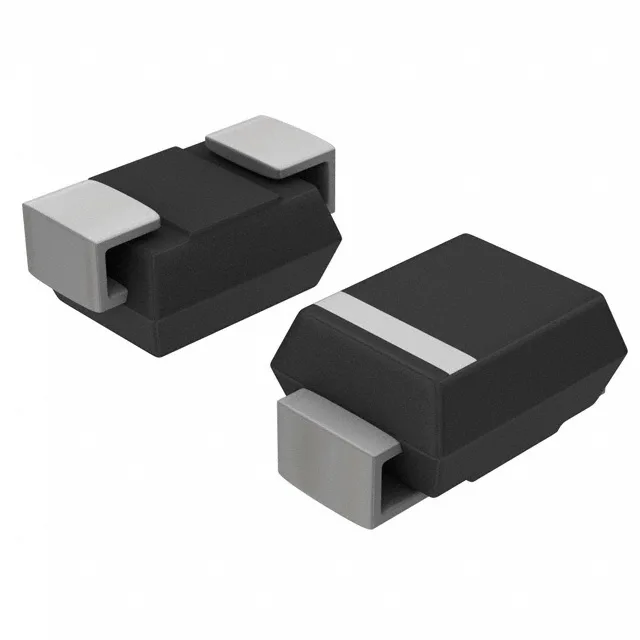
The DO-214AB (SMC) package is the standard large-footprint TVS package for 1.5kW-rated devices. It is a surface-mount package with a wide copper tab on the cathode side that conducts heat into the PCB copper pour during the surge event. The tape-and-reel packaging is compatible with standard pick-and-place lines. The single unidirectional channel means this is one TVS diode in a two-terminal package — the cathode is marked on the body and must be oriented toward the positive rail. The power line protection flag is 'No', which means this device is not designed for AC mains or high-voltage power-line clamping; it is intended for DC rail protection in electronic equipment.