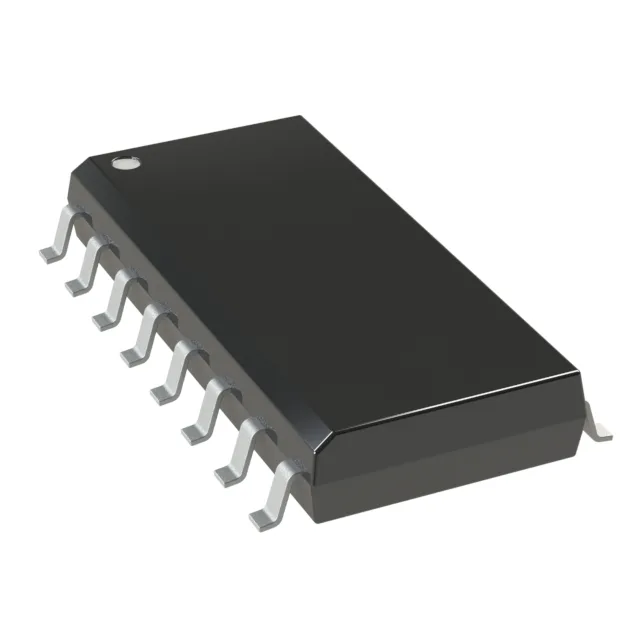
The MAX4638EUE+ is a single 8-channel CMOS analog multiplexer from Analog Devices (formerly Maxim Integrated) that routes one of eight inputs to a common output. Its 3.5Ω max on-resistance keeps signal attenuation low in precision analog paths — you don't need an output buffer for most sub-10kΩ loads. Channel-to-channel matching holds within 100mΩ, so gain errors across channels stay tight without per-channel calibration. Supply flexibility covers the common digital rails: single-supply from 1.8V up to 5.5V, or dual ±2.5V if the design needs bipolar signal swing. The -3dB bandwidth of 50MHz and crosstalk of -85dB at 1MHz mean it handles video-rate multiplexing and audio switching without audible bleed-through.
Switching speed and charge injection — timing budget factors
Max turn-on time is 18ns, turn-off is 7ns. The asymmetry matters: if you're sequencing a multiplexed ADC input, the 18ns window is the one that sets the settling delay before the conversion starts. Charge injection of 13pC is moderate — fine for 12-bit systems with a sample-and-hold, but worth checking against the ADC's acquisition time in 16-bit designs. Off-leakage maxes at 250pA at 25°C, and channel capacitance is 9pF (source off) and 40pF (drain off). The 40pF drain capacitance loads the output bus — if you're paralleling multiple muxes on a shared analog bus, the total capacitance adds up and can limit settling time at high impedance.
Package and rework — 16-TSSOP on a hot-air station
The 16-TSSOP package (4.40mm body width, 0.65mm pitch) is a straightforward hand-solder or hot-air rework job. The 0.65mm pitch means a standard fine-tip iron or a hot-air nozzle at 300°C with a gentle airflow lifts the part clean without lifting pads. No thermal pad underneath, so the board layout is simpler than a QFN. Ships in Tube per the listing, which is fine for bench quantities.