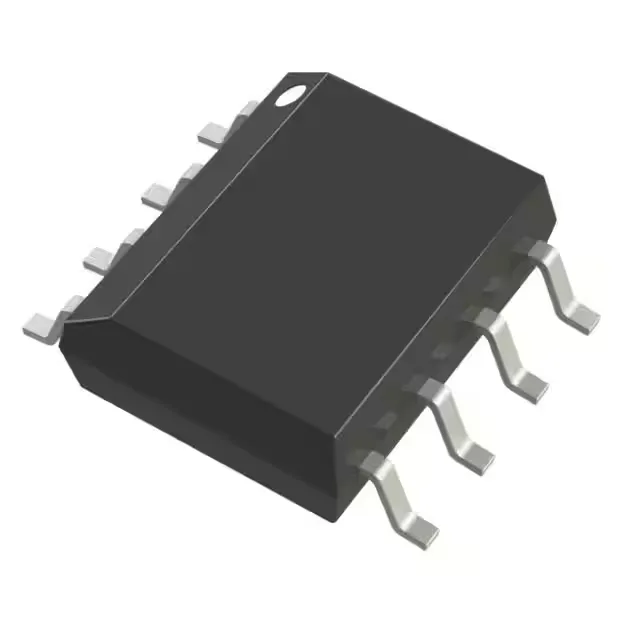
Analog Devices AD622ARZ-RL — Analog & Data Acquisition
Technical Documents PDF / CAD
RoHS Compliant · Lead-Free EIA-481 Standard
Analog Devices / Analog & Data Acquisition

AD622ARZ-RL Instrumentation Amplifier, 1 MHz BW, 8-SOIC

MPN AD622ARZ-RL
End of Life Spot Stock · 24-48h Dispatch 100% Original Sealed

Analog Devices AD622ARZ-RL, Instrumentation Amplifier, 1 Circuit, 1 MHz -3dB Bandwidth, 1.2V/µs Slew Rate, 60 µV Offset, 5.2 V to 36 V Supply, 8-SOIC, -40°C to 85°C.

In Stock: 2,402 pcs
MOQ: 1 pcs
Logistics: DHL / FedEx DAP (Global Express · 3-7d) Russia & CIS DDP (Door-to-Door Cleared)
Dispatch: Shenzhen / HK
Unit Price (USD)
$9.86 / pc
Direct Purchase Ready
Volume Pricing Breaks Confirmed upon quotation
1+ pcs
$9.86
10+ pcs
$8.87
30+ pcs
$8.09
100+ pcs
$7.30
500+ pcs
$6.80
1,000+ pcs
$6.41
Working on a production BOM or have a target unit price? Submit Target Price
Buy Now

$9.86 / ea

2,402 in stock — maximum per order · 3–4 days lead time

$8.87 / ea from 10 pcs

Upload Full BOM List
[SPEC] Essential Parameters Snapshot Full Specifications (13)
Package / Case 8-SOIC (0.154", 3.90mm Width)
Supply Voltage 5.2 V
Output / Current 18 mA
ALT
Facing long factory lead times or allocation on AD622ARZ-RL? Verified pin-compatible alternatives available with active Shenzhen stock and 100% solder-ready footprint match.

Full Technical Specifications

13 Parameters
AD622ARZ-RL specifications
Parameter / AttributeSpecification / Value
MountingSurface Mount
Amplifier typeInstrumentation
Voltage - input offset60 µV
Voltage - supply span5.2 V
Current - supply900µA
Current - input bias2 nA
Current - output (Channel)18 mA
Operating temperature-40°C ~ 85°C
-3db bandwidth1 MHz
PackageTape & Reel (TR); Cut Tape (CT)
Slew rate1.2V/µs
Case8-SOIC (0.154\", 3.90mm Width)
Number of circuits1
100% Footprint Match · Solder-Ready (No PCB Redesign Needed)

Need Stock or a Drop-in Second-Source for AD622ARZ-RL?

Package: DIP-8 / SOIC-8 · Pin-compatible replacements with immediate Shenzhen spot stock

Footprint Match 98%
Supply Chain & Allocation Reality:

The AD620 is the instrumentation amplifier of medical front ends, load cells, thermocouples and every bridge sensor that needed clean differential gain from an eight-pin body - one external resistor sets gains from 1 to 10000, and the part has been the reference point of its class since the 1980s. Its replacement story is unusually polite: the AD8221 was introduced as the higher-performance pin-compatible successor with the SAME gain formula, so the gain resistor carries over; the AD623 opens the single-supply world at lower cost with a DIFFERENT gain formula, so the resistor does not carry over. The family rule for repair is one sentence: the socket is generous, the gain math is not.

Verified Pin-Compatible Replacements (3 verified alternatives)

AD8221 Analog Devices DIP-8 / SOIC-8
100% Drop-in (Zero Code Change)
Availability & Target Pricing:

The Documented Successor with the Same Gain Resistor

Shenzhen Spot Stock (24-48h Dispatch)

Electrical & Core Specs:

Pin-compatible with the same gain transfer function (49.4k divided by RG, plus one): better offset (about 60uV against 125uV), better CMRR (130dB at G=1000 class against 110), higher input impedance and lower bias current - with a slightly lower bandwidth at high gain.

Same +/-2.3V to +/-18V dual-supply envelope.

Compatibility & Drop-In Notes: The calmest substitution in precision analog: same socket, same resistor, better numbers. Re-run the calibration once - the offset improvement moves the zero point the old trim hid.
Package & Solder Footprint: DIP-8 / SOIC-8 identical footprint.
Shenzhen Warehouse Stock & MOQ: Active production; the forward buy for the socket.
AD623 Analog Devices DIP-8 / SOIC-8
Functional Equivalent
Availability & Target Pricing:

The Single-Supply Cousin - Different Gain Math

Shenzhen Spot Stock (24-48h Dispatch)

Electrical & Core Specs:

The single-supply member: 2.7V to 12V single or dual rails, rail-to-rail output, hundreds of microamps of quiescent current - with the gain resistor chosen by a DIFFERENT constant (100k-based against the 49.4k of the AD620 family).

The reason it exists: battery and 3.3V/5V systems where the dual-supply classics do not fit.

Compatibility & Drop-In Notes: The honest pairing: AD623 into an AD620 socket works electrically (single-supply designs often improve), but the gain must be recomputed - and the noise floor is several times higher (tens of nV/root-Hz against single digits), so low-level medical or strain front ends lose performance they were built around.
Package & Solder Footprint: Same 8-pin footprint.
Shenzhen Warehouse Stock & MOQ: Volume stock; the low-cost single-supply default.
INA128 Texas Instruments (Burr-Brown line) DIP-8 / SOIC-8
Pin-to-Pin (Minor Clock/Init Tuning)
Availability & Target Pricing:

The Other Classic of the Socket

Shenzhen Spot Stock (24-48h Dispatch)

Electrical & Core Specs:

The Burr-Brown member of the classic eight-pin instrumentation-amplifier convention: single gain resistor, similar class, widely cross-referenced with the AD620 in instrument designs.

Dual-supply class per the family.

Compatibility & Drop-In Notes: The family caution, stated once: eight-pin instrumentation amplifiers agree on the socket and disagree on the gain arithmetic - AD620/AD8221 share 49.4k, AD623 uses 100k, the TI pair has its own conventions. Every swap ends with the gain recalculated or measured.
Package & Solder Footprint: Standard 8-pin footprint in the classic convention.
Shenzhen Warehouse Stock & MOQ: Stocked for instrument repair where the TI lineage was original.
Buyer & Quality Checklist for Sourcing Alternatives
  • The gain resistor is part of the part number: 49.4k/RG+1 for the AD620/AD8221 family, 100k/RG+1 for the AD623 - a substitution that keeps the resistor keeps the socket and changes the gain. Recompute or measure; never assume.
  • CMRR is why this class exists: bridge and thermocouple front ends live on rejection of common-mode noise. Substituting down the CMRR ladder (AD623 at about 90dB against the AD8221s 130dB class) trades exactly the specification the circuit was designed around.
  • Single-supply substitutes belong where the rails are single: fitting a dual-supply classic into a 5V system or the reverse is a topology question first, an amplifier question second.
  • The gain range ceilings differ (AD620 to 10000, AD8221 documented to 1000): designs at the top of the range should verify the exact configuration before a substitute.
  • Offset trimming discipline: after any substitution, re-zero at the operating temperature - the old trim was hiding the performance of the old part, not calibrating the circuit.
  • Input protection: these front ends see sensors, and sensors see the world - check the input network against the absolute maximums when repairing, because most dead instrumentation amplifiers died of an input event, not of age.
Frequently Asked Technical Questions

Q: Is AD8221 a drop-in replacement for AD620?

A: Yes - pin-compatible with the same gain formula (same RG value carries over) and improved offset, CMRR and input characteristics. The documented gain ceiling differs (1000 against 10000), so verify configurations at the extreme top of the range.

Q: Can I use AD623 instead of AD620?

A: The socket accepts it and single-supply systems often benefit, but the gain formula differs (100k against 49.4k) and the noise floor is several times higher - recompute the gain and check whether the design was built around low-level precision before substituting.

Q: Why does my replaced instrumentation amp read the wrong gain?

A: The families share the eight-pin socket and not the gain arithmetic: identical RG values mean different gains across AD620, AD623 and the TI row. Recalculate from the new part datasheet or measure the actual gain with a known input.

Technical Details & Description

Precision instrumentation amp for industrial signal chains

It delivers a 1 MHz -3dB bandwidth with a 1.2V/µs slew rate, making it suitable for amplifying bridge outputs, thermocouple signals, and ECG leads where common-mode rejection and low noise matter. The 60 µV maximum input offset voltage and 2 nA input bias current define its precision floor — adequate for 12-bit systems without external trimming.

Supply range and single-supply operation

Rated for a supply span from 5.2 V to 36 V, the AD622ARZ-RL runs on a single 5 V logic rail or a ±15 V split supply without reconfiguration. At 18 mA per channel output drive, it can directly feed a microcontroller ADC input or drive a cable through a series resistor.

The surface-mount package is MSL 1 per Analog Devices standard — no bake required before reflow if the sealed bag is intact. For the rework bench: hot-air profile at 260 °C peak, keep the nozzle off the plastic body to avoid die shift.

The tape-and-reel variant (RL suffix) is the standard production reel, not a cut-tape sample.

Frequently asked questions

What is the bandwidth of AD622ARZ-RL?

The -3dB bandwidth is 1 MHz, with a 1.2V/µs slew rate — adequate for precision signals up to audio frequency and low-speed sensor conditioning.

What is the equivalent of AD622ARZ-RL?

The AD627ARZ-RL is the closest functional sibling within the same pin-compatible 8-SOIC footprint, but its bandwidth is only 80 kHz versus 1 MHz. For higher bandwidth needs, the AD8222ACPZ-RL offers 7 MHz in a dual-channel package with a different pinout.

AD622ARZ-RL
Verified Allocation
Quote