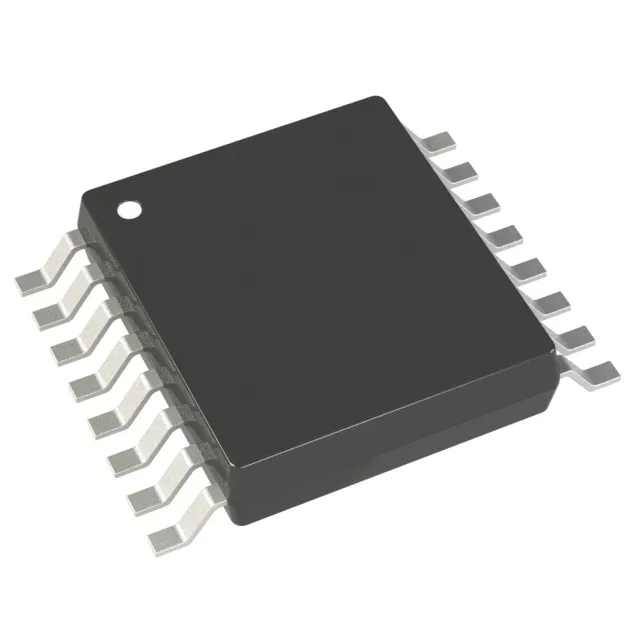
The AD5282BRUZ200-R7 is a dual-channel, linear-taper digital potentiometer from Analog Devices. It presents 200kΩ end-to-end resistance with 256 wiper tap positions, giving a step size of roughly 781 Ω per tap — fine enough for programmable voltage dividers, filter tuning, or gain-setting in op-amp circuits where a mechanical trim pot won't hold calibration. Communication runs over the I²C bus, and each device features a selectable address pin so you can park up to two of these on the same two-wire interface without conflict — handy when you're adjusting multiple bias points from a single microcontroller port. The supply range spans 4.5V to 16.5V on a single rail, or ±5V if you need a bipolar swing for AC-coupled signals. That wide window means it works straight off a 5V or 12V industrial rail without a secondary regulator. Memory is volatile, so the wiper position defaults to mid-scale at power-up — factor that into your power-on state if the circuit expects a known resistance immediately.
200kΩ, 256 taps — sizing the step for your divider
With 256 taps across 200kΩ, the LSB step is about 781 Ω. That's a practical resolution for coarse-gain adjustment in an inverting amplifier or for setting a comparator threshold over a wide range. If your design needs finer steps, a lower-resistance variant (50kΩ or 20kΩ) from the same AD5282 family gives a proportionally smaller step — the 50kΩ version lands at roughly 195 Ω per tap. Tolerance is ±30% on the end-to-end resistance, and the wiper resistance sits at 60 Ω typical. The 30ppm/°C temperature coefficient is typical for a CMOS digipot — expect the absolute resistance to drift with temperature, but the ratiometric accuracy between taps stays tighter. For a voltage-divider application, the ratio error matters more than the absolute value.
Active status — no LTB clock ticking
The 16-TSSOP footprint is a common, easy-to-inspect package that reflows cleanly with a standard lead-free profile.
Where it fits — industrial controls, test gear, audio
The linear taper also makes it a candidate for audio level control in line-stage equipment, though the 200kΩ value is on the high side for modern low-impedance inputs; a 50kΩ variant may pair better with typical audio op-amp stages.