1024-tap non-volatile digital rheostat with I²C
It operates as a two-terminal variable resistor (rheostat configuration), not a voltage divider, so the wiper and one fixed terminal are the signal path. Non-volatile memory retains the wiper setting at power-off — no external EEPROM or microcontroller re-initialization needed at each power-up. The I²C interface supports a selectable address, allowing up to eight devices on the same bus. Supply range covers both single-supply (2.7 V to 5.5 V) and dual-supply (±2.5 V to ±2.75 V) operation, suiting it for AC signal trimming in audio or instrumentation chains.
Rheostat, not a potentiometer — watch the pinout
This part is configured as a rheostat, meaning it has two terminals (wiper and one fixed end) rather than three. If your design expects a voltage-divider (potentiometer) topology, the AD5175BCPZ-10-RL7 won't work directly — you'd need the AD5175's potentiometer variant or a different model. The 1024 taps give approximately 0.1% resolution per step, adequate for fine gain trimming or offset adjustment. Wiper resistance is 35 Ω typical, which adds a small series resistance at the zero-scale position — factor that into your divider budget if the load impedance is below a few kilo-ohms.
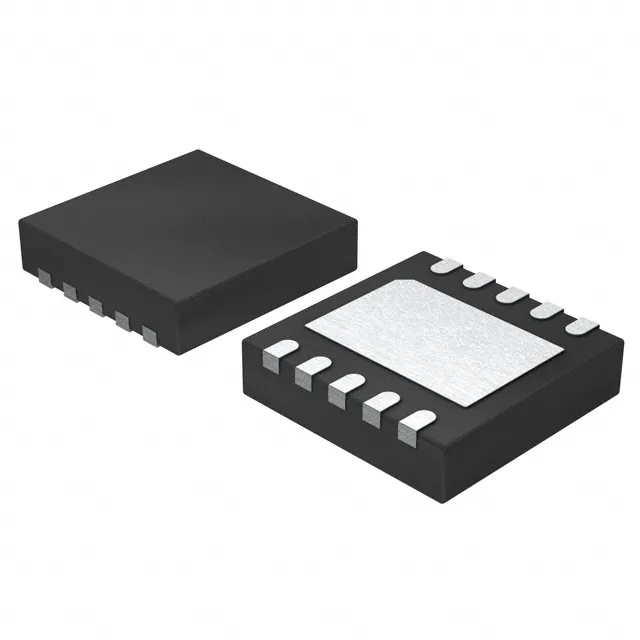
Package and rework: 10-LFCSP with exposed pad
Rework is possible with hot air, but the small body and tight pitch (0.5 mm) demand a steady hand and good stencil alignment. The exposed pad is not electrically isolated — tie it to the same potential as the substrate (usually VSS).
The 35 ppm/°C temperature coefficient on the end-to-end resistance means a 10 kΩ nominal part drifts about 350 Ω over a 100°C swing, which is acceptable for general-purpose trimming but not for precision references. If you need tighter drift, look at the AD5272 family (5 ppm/°C) — though that part comes in a different package and has ±1% tolerance.
ROHS3 compliant. For new designs, this part carries no imminent supply risk.