32.768 kHz — the RTC frequency
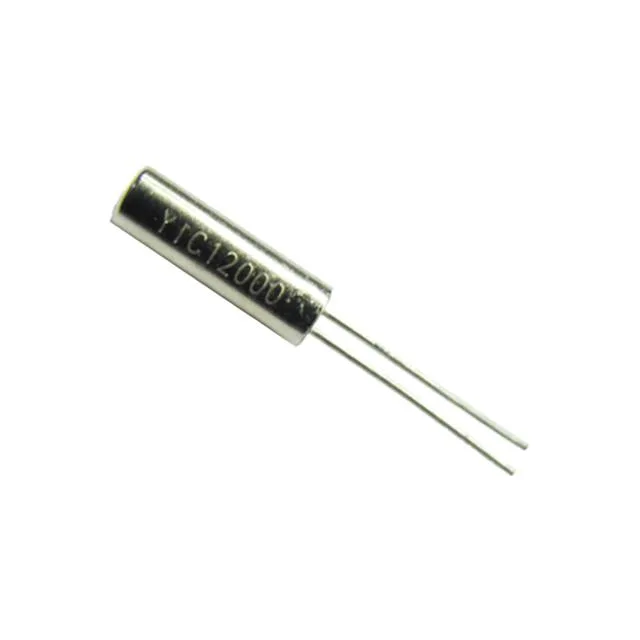
The 32.768K12.5P2/DT38: 32.768 kHz is the standard frequency for real-time clock circuits — it divides cleanly by 2^15 to yield a 1 Hz tick. The ±20ppm frequency tolerance on this DT38 crystal keeps long-term time error under 1.7 seconds per day, well within the drift budget for most calendar and timestamp applications. Load capacitance is 12.5pF — this is the value the surrounding oscillator circuit must match to hit the rated frequency. If the MCU's internal load caps or the PCB trace capacitance sum to something different, the oscillator will pull off frequency by the mismatch. The ESR is 30 kΩ — at 32.768 kHz a tuning fork crystal presents a high-impedance source, so the oscillator gain margin must be adequate. Most microcontrollers with integrated RTC oscillators are designed expecting an ESR in this range; using a crystal with much higher ESR can cause startup failures.
Commercial temperature, through-hole package
Rated -20°C to +70°C — this is the commercial temperature band, suited for indoor instrumentation, consumer electronics, and industrial equipment that does not extend into the extended industrial range. If the application sits in an unheated enclosure or near a heat source, check that the ambient stays within this window. The cylindrical can with radial leads is the classic through-hole form factor for a tuning fork crystal — it drops into a PCB and gets hand-soldered or wave-soldered without special tooling. The 3.00 mm diameter body is compact enough for dense PCB layouts; the radial lead spacing is usually 2.54 mm (0.100 inch) pitch, standard for most RTC oscillator sections. Operating mode is fundamental — the crystal vibrates at its natural resonant frequency without harmonic overtone operation. No external matching network or tuning coil is needed.
Active production — sourcing this part
Sourced to order through independent distribution.