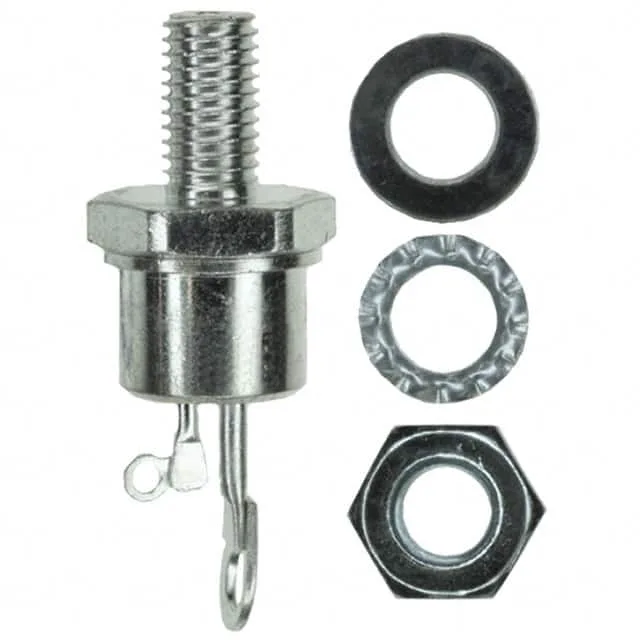
The Vishay VS-2N683 is a standard-recovery silicon controlled rectifier (SCR) in a TO-208AA (TO-48) stud-mount package. It is rated for 100 V off-state blocking voltage and can conduct 25 A RMS (16 A average) on-state current. The stud package is designed for chassis mounting, which means the device's tab or stud is bolted to a heatsink or metal panel — this is the thermal path, not a signal connection. Typical applications include phase-control circuits, motor speed drives, AC power switching, and industrial rectification where the 100 V blocking voltage and 150 A non-repetitive surge capability (at 60 Hz) handle inrush and fault conditions.
Off-state voltage (100 V) sets the maximum peak repetitive voltage the SCR can block when turned off. For a 100 V part, design headroom is tight on a 48 VAC or 60 VDC rail; derating for transients is essential. On-state RMS current (25 A) and average current (16 A) define the continuous load — a 16 A average through a stud-mount device needs a heatsink sized for the junction-to-case thermal resistance. The gate trigger current (40 mA max) and gate trigger voltage (2 V max) are the thresholds to guarantee turn-on; a gate drive circuit must deliver at least 40 mA at 2 V across temperature. The 150 A non-repetitive surge current (60 Hz) is the one-cycle fault rating — useful for sizing fuses and verifying the SCR survives a short-duration overload.
The standard-recovery SCR type means turn-off time is not optimised for high-frequency switching — this is a 50/60 Hz line-frequency device, not for fast-switching inverters.
The TO-208AA (TO-48) is a stud-mount package with a threaded stud for bolting to a chassis or heatsink. The anode is the stud (connected to the metal case), so the mounting surface must be electrically isolated or the heatsink must float. The bulk shipping form means parts arrive loose in a bag or box, not taped and reeled — fine for manual assembly or low-volume builds, but not pick-and-place.