Rectifier ratings and the thermal design decision
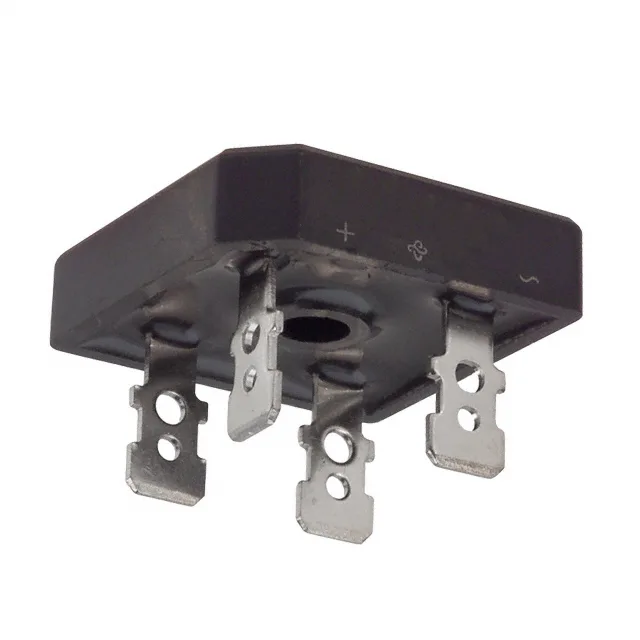
The GBPC1502-E4/51: The Vishay GBPC1502-/51 is a single-phase bridge rectifier rated for 15 A average rectified output (Io) at a peak reverse voltage of 200 V. In a typical DC power supply, the 15 A average is the continuous current the bridge delivers into a capacitive load — the actual silicon die temperature depends on the heatsinking attached to the GBPC package's metal baseplate, not just the load current. The forward voltage drop is specified at 1.1 V maximum at 7.5 A. At full 15 A load the Vf will be higher, so budget the conduction loss (I × Vf) into the thermal path: four diodes conducting in pairs means the junction-to-case thermal resistance governs whether the die stays under the 150 °C TJ limit.
Reverse leakage and the off-state margin
Reverse leakage current is 5 µA at the rated 200 V reverse voltage. That figure is at 25 °C — leakage roughly doubles every 10 °C junction rise, so at 125 °C the off-state loss can approach 1 mA. In a lightly loaded standby supply this leakage current contributes to the no-load power budget and must be accounted for in the transformer secondary design.
Package and mounting for panel or chassis integration
The GBPC package is a 4-Square form factor with QC (quick-connect) terminals — the 0.25-inch tab receptacles mate directly to crimp-on or solder-on female terminals. The metal baseplate is electrically isolated from the die but thermally coupled; bolting it to a chassis or heatsink with thermal grease drops the junction-to-ambient thermal resistance significantly below the free-air figure. The lower end covers cold-start conditions in outdoor equipment; the upper end is the absolute junction limit, not a continuous operating target — derate the output current above 50 °C ambient per the manufacturer's curve.