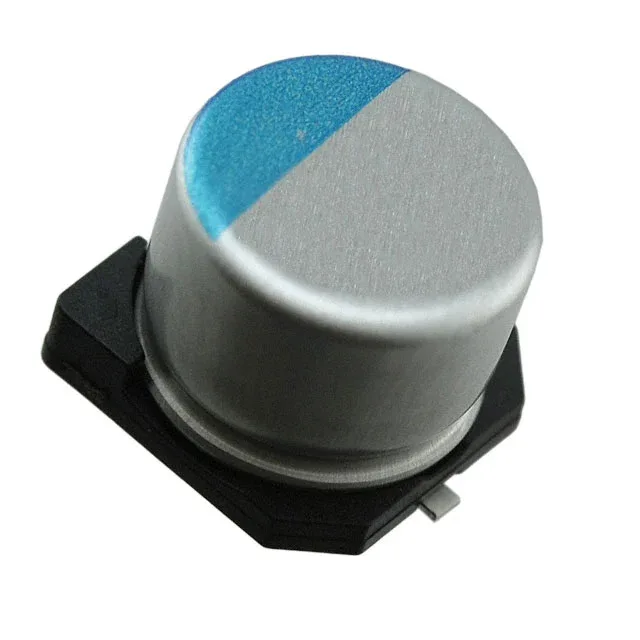
Why the ESR and ripple current rating decide the fit
The APXG200ARA391MJ80G: The 22 mΩ ESR is the headline figure for this polymer cap — it is what separates solid-polymer electrolytics from their wet-electrolyte cousins, and it is specified at 100 kHz, the switching frequency band most relevant for DC-DC output filtering. At that measurement frequency the part delivers 3.65 A of ripple current capability. For a 20 V rail feeding a point-of-load converter, that ripple current rating determines whether the cap sits comfortably inside the switching loop or whether you are pushing it at the thermal limit. A polymer construction handles the ripple-generated self-heating better than a standard electrolytic because the conductivity of the electrolyte is inherently higher — which is the whole point of the polymer type.
Thermal headroom and the 15,000-hour lifetime
The 15,000-hour rating at 105 °C is the derating anchor for the NPCAP-PXG series. At full rated ripple the internal temperature rise above ambient can be significant, so the 105 °C operating ceiling gives you a defined thermal budget to work within — if your board runs 85 °C ambient with modest airflow, you have roughly 20 °C of margin before approaching the rated temperature, which is a comfortable position for a bulk-decoupling role. The -55 to 105 °C temperature range covers the industrial and automotive ambient envelope. For a consumer board running at 85 °C max ambient, the upper limit is not a concern; for a motor-drive inverter housing or outdoor enclosure, the full range matters and the 105 °C ceiling is the limiting factor — not the low end.
Footprint and board integration
The recommended land pattern is 0.406 in by 0.406 in (10.30 mm × 10.30 mm) — a standard pad size for this case diameter that gives the solder joint a compliant interface without requiring a custom footprint. Tape-and-reel packaging with cut-tape option covers both production volumes and prototyping runs.
Active sourcing posture
The part is listed as Active by United Chemi-Con, which means it is a current-production order code with a normal distribution pipeline.