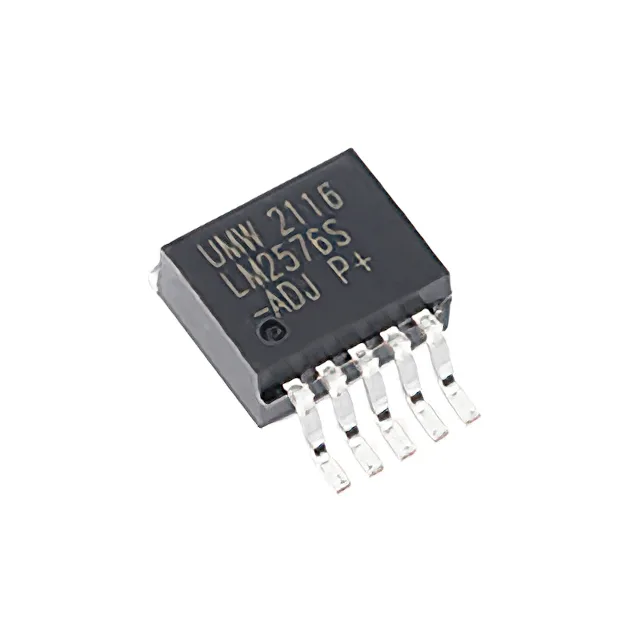
LM2576S-ADJ - UMW
Full Technical Specifications
15 Parameters| Parameter / Attribute | Specification / Value |
|---|---|
| Series | LM2576 |
| Output type | Adjustable |
| Mounting | Surface Mount |
| Voltage - input | 40V |
| Voltage - output | 37V |
| Output current | 3A |
| Frequency - switching | 52kHz |
| I/O channels | 1 |
| Operating temperature | -40°C ~ 125°C (TA) |
| Package | Tape & Reel (TR) Cut Tape (CT) |
| Function | Step-Down |
| Topology | Buck |
| Case | TO-263-6, D2PAK (5 Leads + Tab), TO-263BA |
| Output configuration | Positive |
| Synchronous rectifier | Yes |
Need Stock or a Drop-in Second-Source for LM2576S-ADJ?
Package: TO-220-5 / TO-263-5 · Pin-compatible replacements with immediate Shenzhen spot stock
The LM2576 is the 3A step-down that powered industrial boards and instrument supplies long before the module era: 52kHz switching, a 1.23V feedback reference, and a five-pin outline shared with its later 150kHz sibling. The substitution story has two halves: the upgrade to the LM2596 class, which is pin for pin and keeps the larger 100uH-class inductor working with lower ripple, and the fake-module story running the other way - modules marked with the newer part whose chips switch at about 50kHz with 330-470uH inductors: rebadged 2576-class dies that overheat at rated current. Read the frequency, read the inductor, then read the marking.
Verified Pin-Compatible Replacements (3 verified alternatives)
The 150kHz Successor, Same Five Pins
Shenzhen Spot Stock (24-48h Dispatch)
The upgrade generation: identical pin map (1 VIN, 2 OUT, 3 GND, 4 FB, 5 ON/OFF active-low) and the same 1.23V reference, so the feedback divider carries over untouched; only the switching frequency is different - 150kHz against 52kHz.
Same 3A class up to 40V input (the HV suffix of either family lifts the ceiling to 60V).
The 60V Ceiling for 48V Rails
Shenzhen Spot Stock (24-48h Dispatch)
The high-voltage grade of the same die: the same 52kHz operation and five-pin map with the input ceiling raised from 40V to 60V - the part for 48V industrial rails and telecom-derived supplies.
The whole point of the grade: standard LM2576 stops at 40V input; the HV suffix is rated to 60V.
The 1A Member of the Same Five Pins
Shenzhen Spot Stock (24-48h Dispatch)
The 1A tier of the same 52kHz family: identical pin map and reference, one third of the current - the right-size part for light loads that designs keep oversizing into a 3A socket.
Same input family (HV grades exist in this tier too).
Buyer & Quality Checklist for Sourcing Alternatives
- Pin map and reference are constant across this ladder: 1 VIN, 2 OUT, 3 GND, 4 FB, 5 ON/OFF (active-low), 1.23V feedback in the adjustable grades - so the divider resistors survive an upgrade untouched, and only the magnetics move.
- Frequency drives the magnetics: the 52kHz class asks for about 100uH with 1000uF of output capacitance in the common 5V application, the 150kHz successor uses about 33uH with 220uF. A bigger inductor on a faster part is safe (lower ripple, more size); a smaller inductor on a slow part is ripple current and poor regulation.
- The suffix is part of the part number: the -5.0 and -12 fixed grades wire the feedback internally; the adjustable grades need the external divider. A fixed grade fitted where an adjustable part was outputs its fixed voltage whatever the divider says - check the suffix before debugging the circuit.
- Counterfeit tell at the bench: a module marked with the 150kHz part that switches near 50kHz and carries a 330-470uH inductor holds a 2576-class die. Scope the switch node, read the inductor code - then decide whether to trust the rest of the batch.
- The HV suffix is a voltage decision: 40V against 60V input ceiling. Substituting downward in voltage ends at the first mains transient; substituting upward is free headroom.
- The bill of materials around the part decides the repair: the catch diode (1N5822 / SR340 class), the inductor saturation rating and 105C output capacitors. A genuine regulator in a rebuilt supply with marginal passives fails on schedule.
Frequently Asked Technical Questions
Q: Is the LM2596 a drop-in replacement for the LM2576?
A: Pin for pin, yes: the same five-pin map and the same 1.23V reference, in both TO-220 and TO-263 outlines. The existing 100uH-class inductor works on the 150kHz part with lower ripple. Moving the other way - a 52kHz part on magnetics designed for 150kHz - needs the inductor re-planned.
Q: What is the difference between LM2576 and LM2596?
A: Switching frequency: 52kHz against 150kHz, both 3A and 40V (HV grades 60V). The datasheet application circuits differ in passives - about 100uH with 1000uF against 33uH with 220uF - but the pins and the reference voltage are identical.
Q: Why do some LM2596 modules overheat at rated current?
A: Because the die inside switches near 50kHz - an LM2576-class part under a 2596 marking - and the board was built with passives from the 2596 tables. Scope the switch node frequency and read the inductor value: about 50kHz and 330-470uH means the marking is wrong.