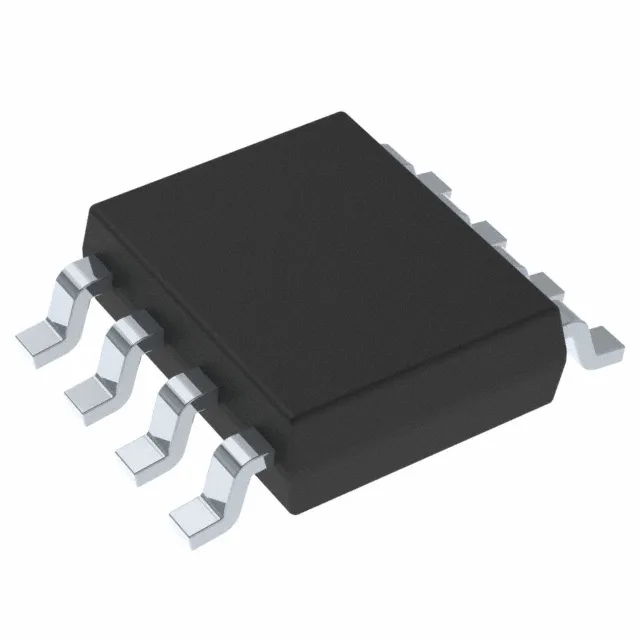
3A peak gate drive — what it buys the power stage
The UCC27200DDA is a Texas Instruments half-bridge gate driver for N-channel MOSFETs, delivering 3A peak source and 3A peak sink current from a single 8V to 17V bias rail. That 3A drive strength lets it charge and discharge the gate capacitance of large TO-220 or TO-247 MOSFETs fast enough to keep switching losses under control in a 100 kHz to 500 kHz hard-switched converter. The high-side driver is bootstrapped, rated to 120V maximum — so this part fits a 48V to 80V bus with margin, but not a 400V telecom rectifier bus.
Switching speed and the layout it demands
Typical rise time is 8 ns and fall time 7 ns into a standard load. That edge rate means the gate-drive loop — from driver output through the gate resistor and back through the source return — must be kept under 1 cm to avoid ringing that exceeds the MOSFET's Vgs rating.
Logic thresholds and 3.3V compatibility
The input logic thresholds are specified at 3V for VIH and 8V for VIL. That 3V VIH means a 3.3V CMOS logic output from an MCU or DSP will reliably drive the input HIGH — no level shifter needed. The 8V VIL threshold is unusually high, so the LOW input must be pulled below 8V, which is straightforward with any 3.3V or 5V logic rail. The two channels are independent and non-inverting, each controlling one half-bridge switch.
Texas Instruments lists this as a current-production device.