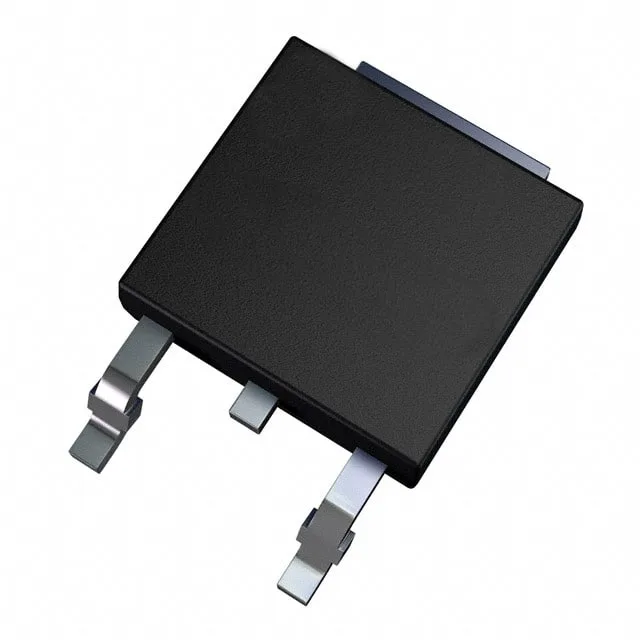
The TPS7A6533QKVURQ1: ROHS3 compliant per the manufacturer's declaration, so no regulatory re-qualification needed for EU or global markets that enforce the RoHS directive.
40V input, 300mA output — the rail it cleans
Rated for a 40 V maximum input and a fixed 3.3 V output at 300 mA continuous. This LDO sits on a high-voltage automotive rail — a 12 V battery bus that sees load-dump transients up to 40 V — and delivers a clean 3.3 V to a microcontroller, sensor, or CAN transceiver without needing a pre-regulator. The 300 mA ceiling covers the typical current draw of an automotive ECU's always-on domain (wake-up logic, RTC, CAN standby) with margin.
PSRR profile — where it filters and where it doesn't
Power-supply rejection ratio is 60 dB at 100 Hz, dropping to 30 dB at 150 kHz. At 100 Hz (the fundamental of an alternator ripple or a mains-rectified supply), 60 dB means the output ripple is 1/1000th of the input ripple — that is clean enough for an analog sensor supply. At 150 kHz (a switching-regulator fundamental), the 30 dB rejection means only 1/30th of the input noise is attenuated; upstream filtering or a post-LDO ferrite bead may be needed to keep the noise off a sensitive analog rail.
AEC-Q100 Grade 0 — the under-hood temperature band
That is the Grade 0 band — the engine-bay, exhaust-adjacent, or brake-system zone where ambient air can hit 125°C and the die sees 150°C under load. A part rated to 150°C junction temperature survives the thermal cycling of a hot soak followed by a cold start without parametric drift. The Automotive, AEC-Q100 series designation means this device passed the full automotive qualification flow: high-temperature operating life (HTOL), temperature cycling, ESD robustness, and latch-up immunity per the AEC-Q100 test methods.
TO-252-3 package — rework and thermal notes
Without that thermal land, the 300 mA output at high input-to-output differential will push the die past the 150°C limit. Three leads with a visible chamfer on pin 1 — orientation is clear under a microscope. The exposed tab is large enough that a hot-air station can reflow it without cooking the adjacent passives, as long as the board is preheated to 100°C to reduce the thermal gradient across the package.
Protection set — integrated fault management
Includes over-current, over-temperature, short-circuit, under-voltage lockout (UVLO), and a watchdog monitor. The watchdog is unusual for a linear regulator — it monitors a digital input and resets the output if the pulse train stops, which means this part can serve as a supervised power rail for a safety-critical microcontroller without a separate supervisor IC. The UVLO holds the output off until the input rail rises above the threshold, preventing the downstream logic from powering up into an undefined state during a cold crank. The over-temperature shutdown protects the die if the thermal pad is poorly soldered or the ambient exceeds the design budget.
Quiescent current and dropout
40 µA typical quiescent current (Iq) — low enough that the regulator's own draw does not dominate the battery budget in a key-off always-on domain. A car parked for 30 days with a 40 µA Iq plus the load current drains roughly 30 mAh from a 60 Ah battery, which is negligible. Maximum dropout voltage is 0.5 V at 250 mA output. On a 3.6 V rail (a Li-ion cell near end-of-discharge), the 0.5 V dropout leaves only 0.1 V of margin, and the output will drop out of regulation as the cell voltage sags further.