Why the 55 dB PSRR matters on this rail
The TPS7A0331PDQNR is a 200 mA LDO with a fixed 3.1 V output, but the spec that decides whether it cleans up a noisy supply rail is the 55 dB power-supply rejection ratio at 1 kHz. That means ripple on the input — from a switching regulator or a digital bus — is attenuated by a factor of roughly 560 before it reaches the load. For an analog front-end or a sensor bias rail where 1 mV of ripple corrupts a 12-bit reading, this matters more than the dropout voltage.
300 nA quiescent — what it buys on a battery
Quiescent current is 300 nA typical. On a 100 mAh coin cell powering a sensor that wakes once a minute, the LDO's own draw is negligible — the battery's self-discharge rate dominates the shelf life. The Enable pin lets a microcontroller gate the output entirely, dropping Iq to near zero between measurement cycles. Dropout voltage is 0.36 V max at the full 200 mA load. If the input rail is a 3.3 V bus with 5% tolerance, the minimum input at 3.135 V still leaves 35 mV of headroom above the 3.1 V output — tight but within spec. Below that margin the output falls out of regulation. Protection features include over-current, over-temperature, and under-voltage lockout (UVLO). The UVLO threshold prevents the output from sourcing current into a shorted input rail — a common failure mode on boards where the LDO's input capacitor holds charge after the upstream supply collapses.
Package and board-fit — 4-X2SON 1x1 mm
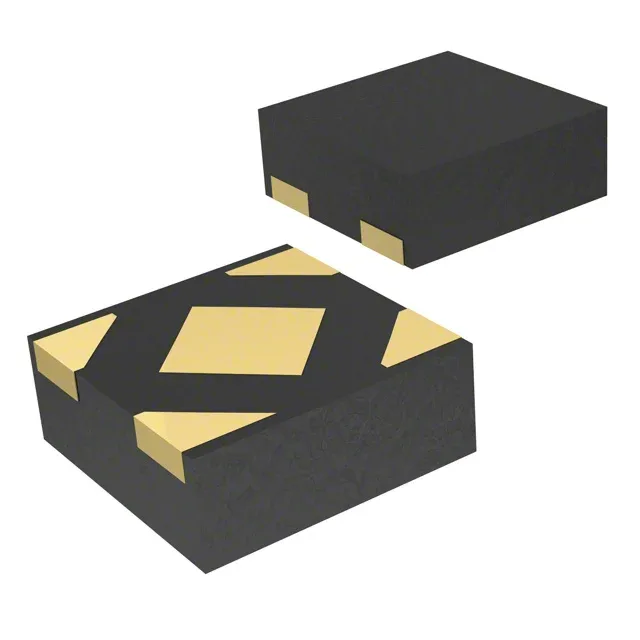
The 4-X2SON package measures 1 mm x 1 mm with an exposed pad — the footprint is smaller than a 0402 resistor. The 4-XDFN Exposed Pad case requires a thermal via under the pad to pull heat into the board plane; without it the junction-to-ambient thermal resistance rises and the 125 °C max junction temperature is reached at a lower ambient. The supplier device package is listed as 4-X2SON (1x1), which is the same physical outline as the XDFN.